
The human brain, an intricate marvel of nature, remains one of the most profound mysteries in the universe. Its ability to process information, generate emotions, form memories, and dictate our very consciousness is a testament to its unparalleled complexity. For centuries, scientists and philosophers have grappled with understanding its inner workings. Today, thanks to groundbreaking advancements in neuroscience and biotechnology, we are closer than ever to unraveling these secrets. At the heart of this revolution are advanced neuroimaging techniques – powerful tools that allow us to peer inside the living brain, observe its activity in real-time, and map its intricate connections.
This article will take you on an illuminating journey through the world of modern brain research, exploring how these sophisticated techniques are transforming our understanding of neural networks, cognitive processes, and neurological disorders. From the subtle dance of neurons and synapse to the grand architecture of the mind, we will delve into the methodologies that are pushing the boundaries of neurology and computational neuroscience, paving the way for unprecedented discoveries and innovative therapeutic approaches. Prepare to discover how these scientific frontiers are not just academic pursuits but hold the key to enhancing human health and potential.
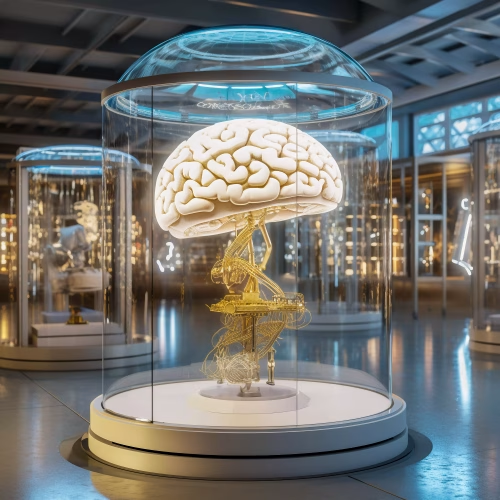
Before the advent of modern neuroimaging, our understanding of the brain was largely derived from post-mortem examinations, lesion studies, and behavioral observations. While these methods provided foundational insights, they offered limited real-time insights into the dynamic processes of a living brain. The late 20th century marked a pivotal shift with the emergence of techniques like Computed Tomography (CT) and Magnetic Resonance Imaging (MRI), which provided unprecedented structural views. However, the true revolution began when functional aspects could be observed. This opened up entirely new avenues for brain research, allowing scientists to correlate specific brain activities with thoughts, emotions, and actions. This historical progression underscores the continuous human quest to understand the most complex organ, a journey driven by curiosity and the relentless pursuit of technological innovation within neuroscience. The ability to non-invasively explore the brain's functions has profoundly impacted fields from psychology to medicine, laying the groundwork for the sophisticated tools we utilize today.
Today, a diverse array of advanced neuroimaging techniques provides a multi-faceted view of the brain. Each technique offers unique advantages, contributing to a holistic understanding of brain function and dysfunction. Here are some of the most prominent:
fMRI measures brain activity by detecting changes in blood flow. When a brain region is active, it consumes more oxygen, leading to increased blood flow. By mapping these changes, fMRI can pinpoint areas of the brain involved in specific cognitive tasks, making it invaluable for studying neural networks and understanding how different parts of the brain communicate. Its non-invasive nature and good spatial resolution make it a cornerstone of modern brain research.
PET scans use radioactive tracers to visualize metabolic processes in the brain, such as glucose metabolism or neurotransmitter activity. This technique is particularly useful for studying brain diseases like Alzheimer's and Parkinson's, and for mapping receptor distribution. PET provides insights into the biochemical underpinnings of brain function, offering a complementary perspective to fMRI in neurology and neuroscience.
EEG measures electrical activity in the brain via electrodes placed on the scalp, while MEG detects magnetic fields produced by electrical currents. Both offer excellent temporal resolution, allowing researchers to track brain activity changes with millisecond precision. This makes them ideal for studying rapid cognitive processes, sleep patterns, and epileptic seizures, providing a dynamic view of how neurons fire and interact within neural networks.
DTI is an MRI-based technique that maps the white matter tracts (nerve fibers) in the brain by tracking the diffusion of water molecules. It allows researchers to visualize the structural connections between different brain regions, providing critical information about the brain’s wiring diagram. Understanding these connections is vital for comprehending how information flows across synapse and through large-scale neural networks, impacting our understanding of both healthy brain function and neurological disorders.
The true power of neuroimaging lies in its ability to reveal the intricate workings of neural networks. By observing which brain regions activate together during specific tasks, scientists can infer how these networks are organized and how they process information. This has profoundly impacted cognitive science, allowing researchers to map the neural correlates of memory, attention, language, decision-making, and even consciousness. For instance, fMRI studies have shown how different parts of the brain collaborate when we recall a memory or solve a complex problem, illustrating the dynamic interplay within these networks. Understanding these patterns is not just academic; it has direct implications for developing targeted interventions for cognitive impairments and mental health conditions. The insights gained from these techniques are continuously refining our models of how the brain computes and experiences the world, pushing the boundaries of what we thought was possible in brain research.
The vast amounts of data generated by advanced neuroimaging techniques require sophisticated analytical tools. This is where computational neuroscience plays a crucial role. This interdisciplinary field uses mathematical models, computer simulations, and data analysis techniques to understand the principles governing the nervous system. Computational models can simulate the behavior of individual neurons, the dynamics of a synapse, or the activity of entire neural networks, helping researchers interpret complex imaging data. For example, computational models can predict how changes in brain connectivity (as seen in DTI) might affect cognitive function, or how specific patterns of electrical activity (from EEG/MEG) relate to underlying neural processes. By integrating experimental data with theoretical models, computational neuroscience provides a framework for making sense of the brain's complexity, leading to more robust theories about brain function and dysfunction. This synergy between data acquisition and computational modeling is accelerating the pace of discovery in neuroscience.
The convergence of biotechnology, neurology, and neuroimaging promises an exciting future for brain research. Innovations in biotechnology are leading to the development of even more precise and powerful imaging agents and techniques, such as optogenetics and advanced microscopy, which can probe neural activity at cellular and sub-cellular levels. These advancements, when combined with sophisticated neuroimaging, will allow for an unprecedented resolution of brain function. Furthermore, the insights gained from understanding neural networks are directly informing the development of novel therapeutic strategies for neurological and psychiatric disorders. From designing better drugs that target specific neural pathways to creating advanced brain-computer interfaces that restore lost function, the synergy between these fields is profound. Imagine a future where personalized medicine for brain disorders is guided by detailed neuroimaging profiles, or where artificial intelligence, inspired by biological neural networks, achieves new levels of cognitive ability. This interdisciplinary approach is not just about understanding the brain; it's about harnessing that knowledge to improve human lives and push the boundaries of what's possible.
The field of neuroscience is evolving at an astonishing pace, driven by continuous innovation in neuroimaging and computational neuroscience. To truly contribute to this dynamic domain, a strong foundation in both theoretical principles and practical applications is essential. This is where Deep Science Workshops and Deep Science Implementation come into play. Our programs are meticulously designed to equip aspiring researchers, clinicians, and enthusiasts with the knowledge and skills required to navigate the complexities of modern brain research. Whether you're interested in mastering the intricacies of fMRI data analysis, understanding the computational models of neural networks, or exploring the latest breakthroughs in biotechnology applied to the brain, our workshops provide hands-on experience and expert guidance. We bridge the gap between fundamental principles and cutting-edge applications, ensuring you gain a comprehensive understanding of how neurons communicate, how synapse function, and how these microscopic elements give rise to macroscopic brain activity. Join a community dedicated to pushing the boundaries of knowledge in neurology and beyond. Elevate your expertise and be part of the next wave of discoveries that will redefine our understanding of the human mind.
Advanced neuroimaging techniques are sophisticated methods used to visualize and analyze the structure and function of the brain and nervous system. These include fMRI, PET, EEG, MEG, and DTI, providing unprecedented insights into brain research and neural activity.
Neuroimaging techniques are crucial for advancing neuroscience by allowing researchers to observe neural networks in action, identify regions involved in specific cognitive functions, and understand neurological disorders. They bridge the gap between microscopic cellular processes (like synapse and neurons) and macroscopic brain activity.
Computational neuroscience uses mathematical models and computer simulations to understand the principles governing the nervous system. It complements neuroimaging by providing frameworks to interpret complex data, predict neural behavior, and simulate the dynamics of neural networks, offering deeper insights into cognitive science.
Learning about biotechnology and neuroscience is vital because these fields are at the forefront of medical innovation and understanding human cognition. They drive advancements in disease treatment, brain-computer interfaces, and artificial intelligence, offering immense career opportunities and contributing to profound societal benefits.