
Explore Exciting Career Opportunities in Neuroscience: From Fundamental Principles to Computational Synapses
The human brain, an organ of unparalleled complexity and wonder, stands as one of the most profound subjects of scientific exploration. Its intricate architecture, composed of billions of interconnected neurons and countless synapses, orchestrates every facet of our existence—from the subtlest thought to the most complex action. As our collective understanding of this remarkable biological system deepens, so too does the landscape of professional possibilities within the expansive and rapidly evolving field of neuroscience. For individuals driven by curiosity to unravel the mysteries of the mind and contribute to groundbreaking advancements, a career in this dynamic domain offers immense intellectual stimulation and the potential for profound societal impact, particularly in health and advanced technology.
This comprehensive article aims to illuminate the diverse and rewarding neuroscience career paths and opportunities available today, guiding aspiring professionals on how to forge a successful future in this vital discipline. From foundational research initiatives that expand our basic understanding to cutting-edge biotech innovations and sophisticated technological applications, this field is brimming with potential. Whether your passion lies in pure scientific discovery, the practical applications of biology, or the fascinating intersection of these areas with computational methodologies, a deep comprehension of the brain remains at the vanguard of modern scientific endeavors.
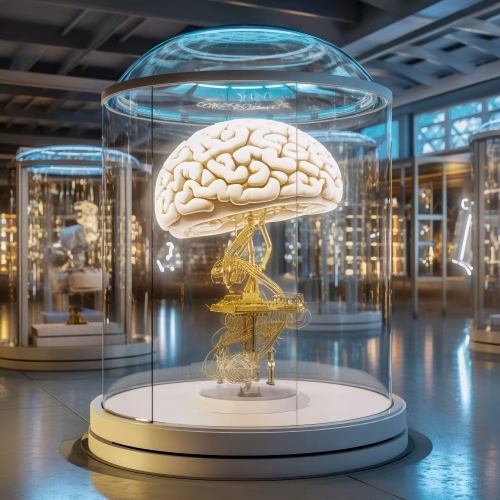
The Multidisciplinary Nature of Neuroscience: Beyond Basic Biology
Neuroscience is inherently interdisciplinary, drawing extensively from a wide array of academic fields including biology, chemistry, physics, computer science, and medicine. This rich, multidisciplinary foundation ensures that the career prospects within this domain are exceptionally broad. It encompasses far more than just microscopic examination of neural tissue; it involves deciphering complex biological systems, engineering novel therapeutic interventions, and even designing advanced artificial intelligence systems inspired by the very neural networks we study.
A prominent avenue for professionals is academic research. Here, individuals work within universities and dedicated research institutions, conducting experiments aimed at elucidating fundamental brain functions, investigating neurological disorders, and exploring intricate cognitive processes. This work frequently involves detailed studies of individual neurons, their communication mechanisms via synapses, and the larger neural circuits that underpin behavior and thought. Roles in academia can lead to esteemed professorships, leadership positions in research laboratories, and the profound opportunity to mentor and shape the next generation of scientific minds. The pursuit of fundamental scientific knowledge in this setting is absolutely critical for achieving long-term, transformative breakthroughs.
Exploring Diverse Career Paths and Opportunities
Beyond the academic sphere, the biotech and pharmaceutical industries present substantial career prospects. Companies in these sectors are continually seeking experts in this domain to develop innovative drugs and treatments for a spectrum of neurological and psychiatric disorders, such as Alzheimer's disease, Parkinson's disease, depression, and epilepsy. This work spans the entire drug development pipeline, from initial discovery and preclinical testing to rigorous clinical trials and navigating complex regulatory affairs. Professionals in this industry segment are instrumental in translating foundational scientific discoveries into tangible, life-changing therapies, effectively bridging the gap between pure research and practical medical application.
The rapid advancement of technology has also opened entirely new frontiers within this scientific discipline. Computational neuroscience, for instance, is a burgeoning area where specialists leverage mathematical models, sophisticated computer simulations, and advanced data analysis techniques to gain deeper insights into brain function. This can involve constructing detailed models of individual neurons, simulating the behavior of vast neural networks, or analyzing massive datasets derived from advanced brain imaging studies. This particular specialization is highly attractive to individuals possessing strong programming and quantitative skills, offering roles such as data scientists, bioinformaticians, and software developers focused on neuro-related applications. The increasing integration of artificial intelligence and machine learning in understanding the brain underscores the dynamic and forward-looking nature of this exciting field.
Clinical neuroscience, conversely, is dedicated to the diagnosis and treatment of neurological conditions. While many positions in this sector necessitate a medical degree (e.g., neurologists, psychiatrists), there are also significant opportunities for scientists with advanced degrees in brain studies to contribute within clinical environments. This includes conducting specialized diagnostic tests, performing neurophysiological monitoring, or contributing to patient-oriented research initiatives. This crucial intersection of biology and direct patient care is paramount for enhancing the quality of life for millions affected by neurological challenges.
Furthermore, the neuro-technology sector is experiencing exponential growth. This encompasses the development of revolutionary tools such as brain-computer interfaces (BCIs), neuroprosthetics, and cutting-edge neuroimaging techniques. Engineers and scientists with a robust background in understanding the nervous system are indispensable for designing, refining, and implementing these devices, which can restore lost function for individuals with disabilities or even augment human capabilities. This area vividly illustrates the powerful convergence of science, engineering, and medicine, continually generating unique roles and innovative avenues for skilled professionals.
Essential Skills for Aspiring Neuroscientists
To excel and thrive across these diverse professional roles, a strong grounding in core scientific principles is absolutely paramount. This includes a profound understanding of biology, particularly cellular and molecular biology, genetics, and physiology. A solid grasp of chemistry and physics is equally crucial for comprehending intricate neural processes and mastering experimental methodologies. Moreover, as the field becomes increasingly data-intensive, proficiency in computational tools and advanced statistical analysis is becoming indispensable. Acquiring skills in programming languages like Python or R, and developing an understanding of machine learning algorithms, can significantly enhance your employability and career trajectory.
Beyond technical competencies, critical thinking, adept problem-solving, and effective communication are vital attributes. The capacity to meticulously design experiments, rigorously analyze complex data, accurately interpret results, and articulate findings clearly to both specialized scientific audiences and the general public is what truly distinguishes successful professionals in this domain. Collaboration is also a cornerstone of modern scientific progress, as many of the most groundbreaking discoveries in this field emerge from synergistic, interdisciplinary teams.
Deep Science Workshops: Your Gateway to Neuroscience Excellence
Navigating the intricate landscape of neuroscience careers demands specialized knowledge and practical, hands-on skills. This is precisely where educational initiatives like Deep Science Workshops prove invaluable. Our comprehensive programs are meticulously designed to equip aspiring neuroscientists with the fundamental principles and advanced techniques necessary to excel in this highly competitive field. Specifically, our flagship "Neuroscience: Fundamental Principles to Computational Synapses" program offers a unique and powerful blend of theoretical understanding and practical experience, thoroughly preparing you for the intellectual challenges and immense rewards of a career in this vital scientific area.
This program meticulously covers a wide spectrum of topics, from the basic anatomy and physiology of the neuron and the intricate mechanisms of synapse function, to advanced subjects in computational modeling and cutting-edge neuroimaging. Participants will gain profound insights into the latest research methodologies, comprehend how technology is fundamentally revolutionizing our understanding of the brain, and develop the essential practical skills required for effective Deep Science Implementation in real-world scenarios. Our curriculum is thoughtfully crafted to ensure you are comprehensively versed in both the foundational science and the cutting-edge applications of this fascinating discipline.
Whether your ultimate goal is an academic position, a pivotal role within a leading biotech firm, or contributing to innovative neuro-technology development, Deep Science Workshops provides the robust educational framework you need. Our team of expert instructors, access to state-of-the-art resources, and an unwavering focus on practical application make our programs an invaluable asset for anyone genuinely serious about a career in understanding the nervous system. We effectively bridge the gap between abstract theoretical knowledge and concrete practical application, ensuring our participants are fully prepared for immediate and meaningful impact in their chosen professional path.
The Future of Neuroscience Careers: A Horizon of Opportunity
The future of neuroscience is exceptionally promising, heralding continuous innovation and an ever-expanding array of professional opportunities. As our understanding of the brain continues to deepen, so too will our capacity to develop more effective treatments for neurological and psychiatric disorders, engineer increasingly sophisticated artificial intelligence systems, and potentially even enhance human cognitive abilities. The powerful convergence of biology, technology, and data science will undoubtedly continue to spawn new specializations and generate significant demand for highly skilled professionals. From the advent of personalized medicine based on individual neural profiles to the creation of advanced neuroprosthetics that restore lost function, the transformative impact of this scientific discipline is poised for exponential growth.
Embracing interdisciplinary learning, diligently staying updated with the latest scientific advancements, and continuously honing both scientific acumen and computational skills will be paramount for long-term success in this field. The journey into neuroscience is inherently one of continuous discovery, offering a unique chance to contribute to resolving some of the most profound scientific and medical challenges of our era. With the right training and unwavering dedication, you can indeed be at the forefront of this exhilarating scientific revolution.
Ready to embark on a transformative journey into the world of neuroscience?
Frequently Asked Questions About Neuroscience Careers
What are the primary career paths in neuroscience?
Neuroscience offers diverse career paths and opportunities including research scientist, clinical neuroscientist, computational neuroscientist, biotechnologist, pharmaceutical researcher, and academic roles. These roles span various sectors from universities to industry.
What skills are essential for a career in neuroscience?
Essential skills include a strong foundation in biology, chemistry, and physics, along with analytical, problem-solving, and computational skills. Interdisciplinary knowledge in data science and programming (e.g., Python, R) is increasingly valuable for analyzing complex data from the brain and neurons.
How can Deep Science Workshops help me pursue a neuroscience career?
Deep Science Workshops offers specialized programs like "Neuroscience: Fundamental Principles to Computational Synapses," providing comprehensive knowledge, practical skills, and hands-on experience crucial for entering and excelling in the field. Our focus on Deep Science Implementation prepares you for real-world challenges.
Is neuroscience a growing field?
Yes, neuroscience is a rapidly expanding field driven by advancements in technology, increased understanding of brain disorders, and the integration of AI and data science, leading to numerous new opportunities. Investment in neuro-research continues to grow globally.
What is the role of technology in modern neuroscience?
Technology plays a pivotal role, enabling advanced brain imaging, computational modeling of neural networks (e.g., synapse function), development of neuroprosthetics, and big data analysis in genetic and molecular neuroscience research. It's transforming how we study and interact with the nervous system.