
The human brain, an intricate marvel of evolution, remains one of the most profound mysteries of the universe. For centuries, scientists have endeavored to unravel its complexities, leading to the emergence of neuroscience – a vast and interdisciplinary field dedicated to understanding the nervous system. Beyond the fundamental quest for knowledge, modern neuroscience research is increasingly focused on its tangible, practical applications that are revolutionizing medicine, technology, and our understanding of human behavior. This article delves into the diverse ways in which insights from brain research are being translated into real-world solutions, from treating debilitating neurological disorders to enhancing artificial intelligence and optimizing learning processes. We will explore how understanding the smallest unit, the synapse, to the grandest scale of neural networks, is paving the way for unprecedented advancements.
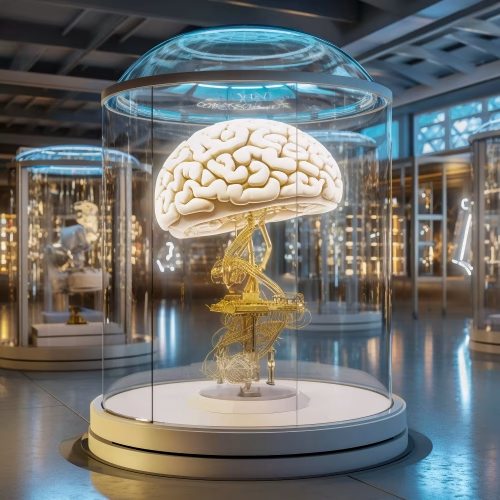
One of the most impactful areas where neuroscience shines is in healthcare. The study of the brain and nervous system is crucial for diagnosing, treating, and preventing a myriad of neurological and psychiatric conditions. For instance, advancements in understanding the cellular and molecular mechanisms of diseases like Alzheimer's, Parkinson's, and epilepsy are leading to more targeted therapies. Brain research has illuminated the pathology of these conditions, offering hope for millions.
Neurotechnology is at the forefront of medical innovation. Consider Brain-Computer Interfaces (BCIs), which allow individuals with severe paralysis to control prosthetic limbs or communicate using only their thoughts. These groundbreaking devices rely on a deep understanding of how neurons fire and how these signals can be decoded and translated into commands. Similarly, advanced neuroimaging techniques like fMRI and PET scans provide unprecedented views of brain activity, aiding in early diagnosis and guiding surgical interventions. The development of new drugs that precisely target specific neural pathways to alleviate pain, depression, or anxiety is another testament to the practical applications of neuroscience.
The human brain is the ultimate biological computer, and its architecture has long inspired the field of artificial intelligence. Neural networks, the backbone of modern AI, are directly modeled on the interconnected structure of biological neurons. The rapid progress in deep learning, a subset of AI, owes much to insights gleaned from how the brain processes information, learns, and adapts. This synergy between neuroscience and AI is creating intelligent systems capable of tasks once thought exclusive to human cognition, such as natural language processing, image recognition, and complex decision-making.
Computational neuroscience plays a pivotal role here, providing the theoretical frameworks and mathematical models necessary to simulate brain functions. By understanding how individual neurons and their synapse connections contribute to emergent behaviors, AI researchers can design more efficient and powerful algorithms. This interdisciplinary approach is not just about mimicking the brain but also about using AI tools to further our understanding of the brain itself, creating a powerful feedback loop for innovation in both fields. The future of neurotechnology and AI is deeply intertwined.
Beyond treating disorders, neuroscience offers profound insights into optimizing healthy brain function. Educational neuroscience, for example, applies principles of brain development and learning to improve teaching methods and curricula. Understanding how memory works, how new information is integrated into existing neural networks, and what factors influence attention and motivation can revolutionize educational practices. This leads to more effective learning strategies and interventions for learning difficulties.
Techniques like neurofeedback, where individuals learn to consciously alter their brainwave patterns, are being explored for improving focus, reducing stress, and enhancing cognitive performance. The study of cognitive science, deeply rooted in neuroscience, explores how we perceive, think, remember, and solve problems, providing actionable insights for personal development and professional training. These practical applications of neuroscience are empowering individuals to unlock their full cognitive potential.
The field of neurotechnology is rapidly expanding, promising a future where our interaction with technology is seamless and intuitive. Wearable devices that monitor brain activity for health insights, neuroprosthetics that restore lost function, and even direct brain-to-brain communication are no longer confined to science fiction. However, this rapid advancement also brings forth critical ethical considerations. Discussions around privacy, autonomy, and the equitable access to these powerful technologies are paramount as neuroscience research continues to push boundaries.
The integration of biotechnology with neurotechnology is accelerating the development of advanced tools, from optogenetics that control neuron activity with light to CRISPR-based gene therapies for neurological conditions. This frontier demands careful consideration and responsible innovation to ensure that these powerful applications benefit humanity broadly and ethically. Understanding the fundamental principles of neurology is essential for navigating this complex landscape.
For those eager to delve deeper into these fascinating fields, programs like "Neuroscience: Fundamental Principles to Computational Synapses" offered by Deep Science Workshops provide an invaluable pathway. These workshops are designed to bridge the gap between theoretical knowledge and the practical applications of neuroscience research. Participants gain hands-on experience with concepts ranging from the basic biology of neurons and the function of the synapse to advanced topics in computational neuroscience and the development of neural networks.
Through immersive learning and practical exercises, Deep Science Implementation focuses on equipping individuals with the skills needed to contribute to this rapidly evolving domain. Whether your interest lies in medical applications, developing cutting-edge AI, or understanding the very fabric of cognition, these programs offer a comprehensive foundation. They are tailored for aspiring researchers, engineers, and anyone passionate about the brain's potential and its real-world impact.
The journey into neuroscience is one of continuous discovery. From the microscopic world of neurons and synapses to the macroscopic complexity of neural networks and cognitive functions, every breakthrough holds the potential to transform lives. The practical applications of neuroscience are not just theoretical concepts; they are tangible solutions addressing some of humanity's greatest challenges. As research continues to advance, fueled by interdisciplinary collaboration and innovative approaches, the future promises even more astonishing developments in brain health, technology, and human understanding.
What are the primary practical applications of neuroscience?
The primary practical applications of neuroscience span medicine (treating neurological disorders, developing brain-computer interfaces), artificial intelligence (designing advanced neural networks), education (optimizing learning processes), and neurotechnology (creating devices for brain monitoring and stimulation). It's a field that bridges fundamental brain research with real-world solutions.
How does computational neuroscience contribute to understanding the brain?
Computational neuroscience uses mathematical models, simulations, and theoretical analysis to understand the principles governing the structure and function of the nervous system. It helps researchers model individual neurons, simulate complex neural networks, and analyze vast datasets from brain research, providing insights that are difficult to obtain through experimental methods alone. This approach is crucial for advancing our understanding of the synapse and overall brain dynamics.
What role does biotechnology play in neuroscience advancements?
Biotechnology is integral to modern neuroscience, providing tools and techniques for gene editing, protein engineering, and advanced imaging that allow scientists to manipulate and observe brain cells with unprecedented precision. This synergy leads to breakthroughs in understanding disease mechanisms, developing novel therapies, and creating sophisticated neurotechnology devices.
Why are Deep Science Workshops important for learning about neuroscience?
Deep Science Workshops and Deep Science Implementation programs offer immersive, hands-on learning experiences that bridge theoretical knowledge with practical skills in fields like neuroscience. They provide a structured environment to explore complex topics from fundamental principles to advanced applications like computational synapses, preparing participants for real-world challenges and innovations in brain research and neurotechnology.