
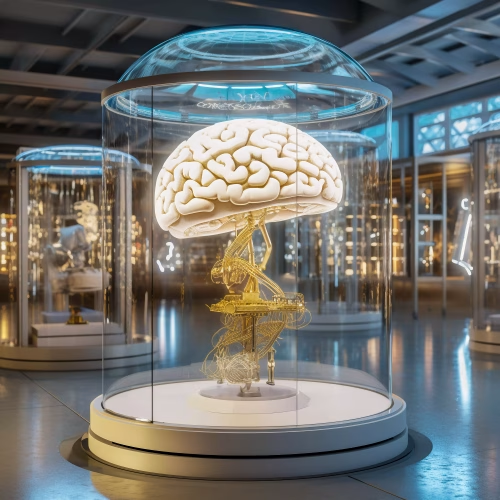
The Historical Divide and Modern Convergence
Historically, psychiatry often operated with a more psychological and behavioral lens, sometimes detached from the tangible biology of the brain. Mental illnesses were frequently viewed through psychoanalytic frameworks or as character flaws. However, the mid-20th century saw a shift, driven by early discoveries in psychopharmacology and a growing recognition that the brain was the central organ of mental life. This marked the beginning of the convergence. Today, neuroscience provides the foundational knowledge, explaining how neurons communicate, how neural networks form and adapt, and how disruptions in these processes can lead to conditions like depression, anxiety disorders, schizophrenia, and bipolar disorder. This integration of neuroscience into psychiatry has been pivotal, moving the field towards a truly evidence-based, biological understanding of mental health.
Unraveling Brain Function: From Neurons to Networks
At the heart of neuroscience lies the study of the neuron, the fundamental building block of the brain. Understanding how these cells transmit signals across synapses—the tiny junctions where information is exchanged—is crucial. Dysregulation in neurotransmitter systems (like dopamine, serotonin, and norepinephrine) is implicated in numerous psychiatric conditions. Modern research employs sophisticated techniques to map neural pathways and observe brain activity in real-time. Functional magnetic resonance imaging (fMRI), electroencephalography (EEG), and optogenetics are just a few examples of tools that allow scientists to visualize the brain in action, identifying regions involved in specific emotions, thoughts, or behaviors. This detailed understanding of brain function is invaluable for psychiatry, helping to pinpoint the neural correlates of symptoms and to develop interventions that specifically target these areas.
The Role of Genetics and Epigenetics
The influence of genetics on mental health is a rapidly expanding area of research. While no single gene causes complex psychiatric disorders, genetic predispositions play a significant role. Neuroscience is at the forefront of identifying specific genetic variants associated with increased risk for conditions like schizophrenia, autism spectrum disorder, and bipolar disorder. Beyond direct genetic inheritance, epigenetics—the study of how environmental factors can influence gene expression without altering the DNA sequence—is also gaining prominence. Stress, trauma, and early life experiences can leave epigenetic marks on the brain, potentially increasing vulnerability to mental illness later in life. This intricate interplay between genetics, environment, and brain biology offers a more holistic understanding of mental health conditions, guiding psychiatry towards personalized medicine approaches.
Biotechnology and Therapeutic Innovation
Biotechnology has emerged as a powerful ally in the quest to understand and treat psychiatric disorders. From developing new diagnostic tools to engineering novel therapeutic agents, biotechnology is transforming the landscape of medicine and neurology. For instance, advancements in drug discovery, informed by a deeper understanding of receptor biology and neural pathways, have led to more targeted psychopharmaceuticals with fewer side effects. Gene therapy and neuromodulation techniques, such as transcranial magnetic stimulation (TMS) and deep brain stimulation (DBS), represent cutting-edge applications of biotechnology that directly interact with brain circuits to alleviate symptoms. These innovations are not just incremental improvements; they represent paradigm shifts in how psychiatry can intervene, offering hope for patients who have not responded to traditional treatments. Deep Science Workshops and Deep Science Implementation are at the forefront of disseminating this knowledge.
Computational Neuroscience and Synaptic Plasticity
The field of computational neuroscience bridges the gap between theoretical models and empirical observations, using mathematical tools and computer simulations to understand the complex dynamics of the brain. This area of research is particularly relevant to understanding synapse plasticity—the ability of synapses to strengthen or weaken over time, which is fundamental to learning and memory. Disruptions in synaptic plasticity are increasingly recognized as key contributors to various psychiatric and neurological disorders. By modeling these processes, computational neuroscience can help predict how different interventions might affect neural circuits, guiding the development of new therapies. This interdisciplinary approach, combining biology, science, and advanced computing, is crucial for unraveling the mysteries of the brain and applying this knowledge in psychiatry.
The Future of Neuroscience and Psychiatry
The future of neuroscience and psychiatry is incredibly promising. Continued research into the brain's connectome—the comprehensive map of neural connections—will provide unprecedented detail about how different brain regions communicate. Advances in artificial intelligence and machine learning are poised to revolutionize diagnostics and treatment planning, enabling clinicians to analyze vast amounts of data, from genetic profiles to neuroimaging scans, to create highly personalized treatment strategies. The integration of digital therapeutics, virtual reality, and wearable technologies will also play an increasingly important role in monitoring mental health and delivering interventions. As our understanding of the biology of the brain deepens, so too will our capacity to prevent, diagnose, and treat mental illness with greater precision and efficacy. This exciting frontier demands continuous learning and adaptation, which is precisely what programs like those offered by Deep Science Workshops aim to foster.
Conclusion
The journey from abstract psychological theories to a concrete biological understanding of mental health has been long and arduous, but the collaboration between neuroscience and psychiatry has accelerated this progress dramatically. By focusing on the brain as the central organ of mental life, and leveraging breakthroughs in biotechnology, genetics, and computational science, we are gaining unprecedented insights into the mechanisms of psychiatric disorders. This profound connection is not just academic; it is transforming patient care, offering new hope through innovative treatments and a more compassionate understanding of those affected by mental illness. For anyone passionate about unraveling the mysteries of the brain and contributing to the advancement of medicine, exploring the depths of neuroscience is an essential step. Join us at Deep Science Workshops and Deep Science Implementation to be part of this transformative journey.