
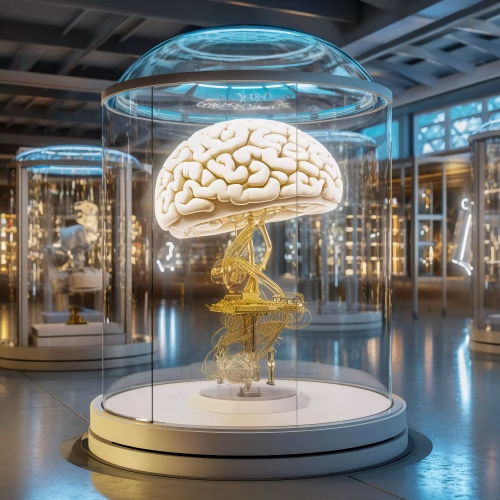
The Dynamic Landscape of Neuroscience and Biotechnology
Neuroscience is inherently interdisciplinary, drawing from biology, chemistry, physics, psychology, computer science, and engineering. This convergence creates a rich environment for innovation and diverse jobs. The integration of biotechnology has particularly accelerated progress, enabling researchers to manipulate genes, visualize neural activity with unprecedented detail, and develop advanced tools for diagnosis and treatment. This synergy between pure science and applied technology means that individuals with a wide range of backgrounds can find their niche in the neuroscience industry.
The global demand for solutions to neurological disorders like Alzheimer's, Parkinson's, depression, and stroke continues to rise, fueling significant investment in neuroscience research and development. This investment translates directly into a robust job market, offering stable and evolving careers for those with the right skills and passion. The continuous breakthroughs in understanding the brain's complexities ensure that this field remains at the forefront of scientific discovery, promising a future filled with exciting challenges and opportunities for every student and professional.
Diverse Career Pathways in the Neuroscience Industry
The beauty of pursuing careers in neuroscience lies in the sheer breadth of options available. Here are some key areas where you can make a significant impact:
1. Research and Academia: Unraveling the Brain's Mysteries
Many neuroscience careers begin or thrive in academic institutions and dedicated research centers. Here, scientists conduct fundamental and translational research to deepen our understanding of brain function, development, and disease. Typical jobs include:
- Research Scientist/Associate: Designing and executing experiments in a lab setting.
- Postdoctoral Researcher: Advanced training and independent research after a Ph.D.
- University Faculty: Professors and lecturers who conduct research, teach, and mentor students.
- Lab Manager/Technician: Providing essential support for experiments, managing equipment, and ensuring smooth lab operations.
These roles are crucial for pushing the boundaries of basic science, forming the foundation upon which all other advancements are built. A strong background in experimental design, data analysis, and scientific writing is paramount here.
2. Biotechnology and Pharmaceutical Industry: From Bench to Bedside
The private sector, particularly the biotechnology and pharmaceutical industry, offers some of the most dynamic jobs in neuroscience. Companies are actively involved in drug discovery, developing novel therapeutics for neurological and psychiatric disorders, and creating diagnostic tools. Careers in this sector include:
- Drug Discovery Scientist: Identifying potential drug targets and screening compounds.
- Clinical Research Associate/Manager: Overseeing clinical trials for new neurological treatments.
- Medical Science Liaison (MSL): Bridging the gap between pharmaceutical companies and medical professionals.
- Bioprocess Engineer: Scaling up the production of biological therapies.
These careers often require a blend of scientific expertise and business acumen, with a strong emphasis on regulatory affairs and product development. The impact of these roles directly translates into improved patient outcomes, making them incredibly rewarding.
3. Computational Neuroscience and Data Science: Decoding Neural Data
As neuroscience generates massive datasets (from brain imaging to genetic sequencing), the demand for professionals skilled in computational analysis is soaring. Computational neuroscience is a rapidly growing area, offering exciting jobs for those with strong analytical and programming skills. Roles include:
- Computational Neuroscientist: Developing mathematical models of brain function.
- Neuroimaging Scientist: Analyzing fMRI, EEG, and other brain imaging data.
- Data Scientist (Neuroscience): Applying machine learning and AI to large neural datasets.
These careers are pivotal in extracting meaningful insights from complex biological information, accelerating the pace of discovery in the neuroscience industry.
4. Neuro-tech and Medical Devices: Innovating for the Future
The intersection of neuroscience, engineering, and biotechnology has given rise to a vibrant neuro-tech sector. This area focuses on developing advanced medical devices, brain-computer interfaces (BCIs), neuro-prosthetics, and diagnostic equipment. Jobs in this field include:
- Biomedical Engineer: Designing and testing neuro-devices.
- Software Engineer (Neuro-tech): Developing algorithms for BCIs and neuro-stimulation.
- Product Development Specialist: Bringing innovative neuro-technologies to market.
These careers are at the forefront of applying scientific knowledge to create tangible solutions that enhance human capabilities and treat neurological conditions. The industry is booming with innovation, offering a dynamic environment for those who love to build and create.
Essential Skills and Educational Pathways
To thrive in the neuroscience industry, a strong educational foundation is paramount. Most careers in research and development require at least a Bachelor's degree in neuroscience, biology, biotechnology, psychology, or a related scientific field. For advanced research, academic faculty positions, or senior roles in industry, a Master's or Ph.D. is often necessary.
Beyond formal education, certain skills are highly valued:
- Critical Thinking & Problem-Solving: Essential for designing experiments and interpreting complex data.
- Analytical Skills: Proficiency in statistics, data analysis software, and programming languages (e.g., Python, R).
- Communication: Ability to articulate complex scientific concepts to diverse audiences, both written and oral.
- Collaboration: Neuroscience is highly collaborative; teamwork is key in any lab or industry setting.
- Adaptability: The field is constantly evolving, requiring continuous learning and flexibility.
Navigating Your Career Path: Deep Science Workshops
For students and professionals looking to gain a competitive edge and practical skills, specialized training programs are invaluable. Deep Science Workshops and Deep Science Implementation programs are designed to bridge the gap between theoretical knowledge and real-world application. These workshops offer hands-on experience in cutting-edge techniques, expose participants to industry best practices, and provide networking opportunities with leading experts. Whether you're aiming for a research position, a role in the biotechnology industry, or a specialized computational neuroscience job, these programs can significantly enhance your resume and prepare you for the demands of the modern lab and industry.
Investing in such practical training can accelerate your entry into the field and open doors to advanced careers that might otherwise be out of reach. It’s an excellent way for students to explore different facets of neuroscience and discover their true passion.
The Impact and Future of Neuroscience Careers
Choosing a career in neuroscience means contributing to one of humanity's most profound quests: understanding ourselves. The advancements made in this field have direct implications for public health, from developing new treatments for debilitating diseases to enhancing cognitive function and understanding mental well-being. The future of the neuroscience industry is bright, promising continued growth driven by technological innovation and an ever-increasing appreciation for the importance of brain health.
As a professional in this field, you will be at the forefront of discovery, working on challenges that have the potential to transform lives globally. The interdisciplinary nature ensures that there is always something new to learn, making it a perpetually stimulating and intellectually rewarding path. Whether you are a budding student or an experienced professional, the opportunities to make a lasting impact in science are immense.