
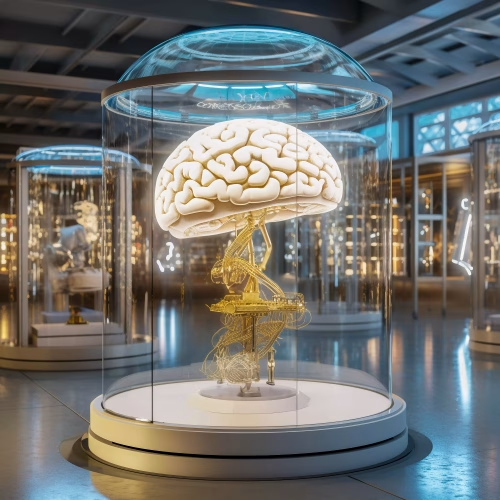
The Biological Blueprint: Unraveling Neuroscience Fundamentals
At the heart of the human brain lies an astonishingly complex network comprising an estimated 86 billion neurons, each capable of forming thousands of connections with other neurons via specialized junctions known as synapses. These biological neural networks are the fundamental units of information processing, orchestrating everything from simple reflexes and sensory perception to complex cognitive functions like abstract thought, memory formation, and emotional regulation. Each neuron acts as a tiny, sophisticated processor, receiving electrochemical signals from its neighbors, integrating these inputs, and then transmitting its own signals if a certain threshold of activation is met. The remarkable strength and efficiency of these synaptic connections are highly plastic, meaning they can be strengthened or weakened over time based on activity patterns, a dynamic process crucial for learning, memory consolidation, and behavioral adaptation. This inherent adaptability is a key feature that artificial systems strive to emulate, albeit in a simplified digital form.
Neuroscience, as the comprehensive scientific study of the nervous system, is dedicated to unraveling these profound mysteries of the brain. Researchers in this field employ a wide array of sophisticated tools and techniques, often relying on cutting-edge lab equipment, to observe, measure, and even manipulate neural activity with increasing precision and resolution. From electrophysiology, which records the electrical impulses of individual neurons or groups of neurons, to advanced imaging techniques like functional Magnetic Resonance Imaging (fMRI) and optogenetics that allow visualization and control of brain function at cellular and circuit levels, the field is constantly pushing the boundaries of our understanding of the brain's intricate workings. This foundational biological knowledge provides the direct inspiration and often the architectural models for artificial intelligence systems, particularly in the rapidly advancing realm of deep learning. Understanding these biological mechanisms is paramount for anyone aspiring to contribute meaningfully to brain-inspired AI development and its diverse applications in modern biotechnology, including neuroprosthetics and therapeutic interventions.
The Digital Echo: Understanding Artificial Neural Networks in AI
Inspired directly by the brain's remarkable architecture, artificial neural networks (ANNs) form the backbone of much of modern AI. These computational models consist of interconnected nodes, often referred to as "artificial neurons" or "perceptrons," organized into distinct layers: an input layer that receives data, one or more hidden layers where complex computations occur, and an output layer that produces the final result. Information flows through these layers, with each connection between nodes having a numerical "weight" associated with it, which is analogous to the strength of a biological synapse. During the learning process, known as training, these weights are iteratively adjusted based on the input data and the desired output. This iterative adjustment allows the network to learn intricate patterns, make accurate predictions, and perform complex tasks such as image recognition, natural language processing, speech synthesis, and strategic game playing. This iterative adjustment is precisely what gives these networks their powerful and adaptive learning capabilities.
The development of deep learning, a transformative subfield of machine learning that utilizes neural networks with many hidden layers (hence "deep"), has revolutionized the capabilities of AI across virtually every domain. This unprecedented advancement has been primarily fueled by three critical factors: vastly increased computational power (especially with GPUs), access to immense datasets for training, and the invention of sophisticated algorithms that enable these deep networks to learn incredibly intricate representations from raw, unstructured data. While artificial neural networks are inherently simplified abstractions of their biological counterparts, their profound success unequivocally underscores the power and efficiency of the brain's fundamental design principles. The continuous evolution of these computational models often draws direct parallels and renewed inspiration from ongoing neuroscience research, creating a fertile ground for truly interdisciplinary collaboration and innovation in the realm of computational intelligence and machine learning.
Bridging the Gap: The Interdisciplinary Synapse of AI and Neuroscience
The convergence of AI and neuroscience is not merely coincidental or a matter of parallel development; it's a deliberate and increasingly fruitful collaboration that promises to unlock new frontiers in both fields. Researchers are actively exploring how detailed insights into fundamental brain function can lead to the creation of more efficient, robust, and interpretable AI systems. For instance, understanding how the brain handles uncertainty, processes complex sensory information (like vision and hearing), or forms and retrieves memories can directly inform the design of novel AI architectures and more biologically plausible learning rules. Concepts like attention mechanisms in deep learning, for example, have direct roots in how the brain selectively focuses on relevant information while filtering out distractions, demonstrating a clear and productive cross-pollination of ideas and methodologies.
Conversely, AI is rapidly becoming an indispensable tool for accelerating neuroscience research itself. Advanced machine learning algorithms are now routinely used to analyze massive neuroimaging datasets, identify subtle patterns in neural activity that human observers might miss, and even simulate complex brain functions to test hypotheses. This symbiotic relationship accelerates discovery in both fields, pushing the boundaries of what's possible in understanding intelligence. Attending a dedicated conference on computational neuroscience, neuro-inspired AI, or brain-computer interfaces can provide invaluable insights into these cutting-edge developments, showcasing the latest breakthroughs and fostering collaboration among leading minds. Furthermore, the practical application of these theoretical models often requires specialized knowledge in biotechnology, particularly in developing sophisticated interfaces and sensors that seamlessly bridge the biological and digital worlds, leading to transformative advancements like advanced neuroprosthetics and targeted neural therapies.
Real-World Applications and Emerging Research Frontiers
The practical implications of this powerful synergy between neuroscience, AI, and biotechnology are vast, profoundly impactful, and continue to transform numerous sectors. In the medical field, for instance, AI-powered analysis of intricate brain scans (such as MRIs and CTs) significantly aids in the early and accurate diagnosis of complex neurological disorders like Alzheimer's disease, Parkinson's disease, and epilepsy, enabling earlier intervention and better patient outcomes. Simultaneously, neuro-inspired AI is being actively developed for advanced prosthetics that can be controlled by thought, offering unprecedented levels of intuitive control and restoring greater independence for individuals with limb loss or paralysis. Biotechnology plays a truly pivotal role here, providing the essential means to interface directly and safely with the nervous system, from designing biocompatible implants to developing advanced biosensors.
Ongoing research at leading institutions worldwide continues to push the boundaries of what is conceivable at this intersection. Scientists are actively exploring neuromorphic computing, a revolutionary approach that aims to build computer hardware that mimics the brain's structure and function more closely than traditional architectures. This offers immense potential for highly energy-efficient AI systems that can process information in fundamentally new, brain-like ways. This endeavor involves significant investment in specialized lab equipment and fosters truly interdisciplinary teams comprised of engineers, biologists, computer scientists, and material scientists. The profound insights gained from studying biological neural networks are not just about building better AI; they also deepen our fundamental understanding of consciousness, learning, memory, and intelligence itself. The future promises even more profound breakthroughs as these fields continue to intertwine and inspire one another, leading to innovations that were once considered science fiction.
Navigating Career Opportunities and the Future Outlook
The burgeoning intersection of neuroscience, AI, and biotechnology has created a wealth of exciting and rapidly expanding career opportunities for those with interdisciplinary skills and a passion for innovation. The demand for professionals who can navigate these complex and evolving domains is growing exponentially across various industries, from healthcare and pharmaceuticals to technology and defense. Roles range from computational neuroscientists who model brain activity and develop theoretical frameworks for understanding cognition, to AI engineers specializing in biomedical applications and large-scale data analysis, and biotech specialists designing cutting-edge neuro-interfacing devices. The landscape of biotech jobs is expanding at an unprecedented rate, offering diverse pathways for impact.
These highly sought-after roles often require a unique blend of skills, encompassing a deep understanding of biological principles, strong programming proficiency, advanced statistical analysis capabilities, and keen analytical thinking. For those looking to enter or advance significantly in this dynamic field, continuous learning and specialized training are absolutely key. Participating in intensive, hands-on programs like Deep Science Workshops or engaging with Deep Science Implementation initiatives can provide the practical skills, theoretical depth, and industry connections needed to succeed. An accessible and comprehensive online course focused on the fundamental principles of neuroscience and computational synapses is an excellent starting point, offering flexibility and comprehensive coverage of essential concepts. The future is exceptionally bright for individuals equipped with knowledge at this fascinating crossroads, promising impactful contributions to both scientific discovery and societal well-being on a global scale.
Deepening Your Understanding: Join Our Journey into the Future
The intricate dance between biological neural networks and AI represents one of the most exciting and impactful frontiers in modern science and technology. To truly grasp the nuances of this rapidly evolving field, from the fundamental workings of a biological synapse to the complex algorithms of deep learning AI, requires dedicated study, practical application, and a commitment to lifelong learning. Whether you are a curious student eager to explore new horizons, an experienced researcher looking to expand your expertise into interdisciplinary areas, or a professional seeking to pivot into this cutting-edge domain, structured learning pathways are essential for navigating its complexities and contributing meaningfully to its advancements.
At Deep Science Workshops, we are profoundly committed to fostering a deeper understanding of these critical and interconnected areas. Our comprehensive programs, including the highly acclaimed 'Neuroscience: Fundamental Principles to Computational Synapses' online course, are meticulously designed to provide you with the foundational knowledge, advanced skills, and practical insights necessary to excel in this transformative field. Through expert-led instruction, engaging hands-on exercises, and insights drawn directly from the latest research and findings presented at leading scientific conferences worldwide, you will gain a holistic perspective on how biotechnology, neuroscience, and AI converge to create revolutionary solutions. This is your unparalleled opportunity to be at the forefront of innovation, contributing to the next wave of scientific discovery and technological advancement that will shape our world for decades to come. Explore the possibilities and unlock your immense potential in a field that is not just evolving, but actively redefining what is possible for humanity.