
Welcome to the forefront of brain science! In an era where understanding the complexities of the brain is paramount, mastering cutting-edge research methods in neuroscience is not just an advantage—it's a necessity. This article delves into the profound impact of advanced techniques in neuroscience, exploring how they are revolutionizing our grasp of brain research, from the intricate dance of neural networks to the fundamental mechanisms of a single synapse. Join us as we uncover the exciting world of neurotechnology, cognitive science, and the burgeoning field of computational neuroscience, all underpinned by robust principles of neurobiology. Prepare to embark on a journey that transcends traditional boundaries, offering insights into the very essence of thought and perception.
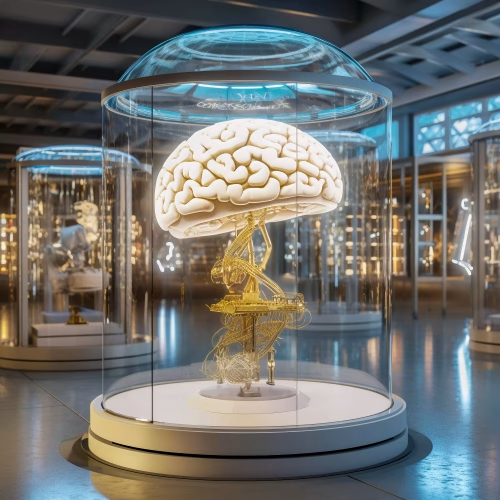
The field of neuroscience is experiencing an unprecedented boom, driven by technological advancements that allow us to probe the brain with unparalleled precision. Traditional research methods are being augmented, and often superseded, by innovative approaches that provide deeper insights into brain function and dysfunction. From optogenetics, which uses light to control neurons, to advanced neuroimaging techniques like fMRI and DTI, the tools available for brain research are more sophisticated than ever. These advancements are crucial for understanding complex neurological disorders and developing effective treatments. Our programs at Deep Science Workshops focus on equipping you with these essential skills, ensuring you are at the cutting edge of discovery.
At the heart of all brain activity lie neural networks – intricate webs of interconnected neurons that process and transmit information. Understanding how these networks operate, and how they are affected by learning, memory, and disease, is a central challenge in neuroscience. A key component of these networks is the synapse, the tiny junction where neurons communicate. Disruptions at the synaptic level can have profound implications for cognitive function. Through our specialized training, you will gain a comprehensive understanding of synaptic physiology and plasticity, employing advanced research methods to explore their roles in health and disease. This knowledge is vital for anyone looking to make a significant impact in neurobiology and related fields.
The convergence of engineering and neuroscience has given rise to neurotechnology, a rapidly expanding domain that includes brain-computer interfaces (BCIs), neural prosthetics, and advanced diagnostic tools. These technologies are not only revolutionizing clinical practice but also providing new avenues for fundamental brain research. Hand-in-hand with neurotechnology is computational neuroscience, a discipline that uses mathematical models, simulations, and theoretical analysis to understand the brain. This approach allows researchers to test hypotheses about neural networks, predict the behavior of complex systems, and interpret vast datasets generated by modern research methods. Our programs emphasize practical application, enabling you to bridge the gap between theoretical models and real-world neuroscientific challenges.
Cognitive science is an interdisciplinary field that explores the nature of thought, perception, memory, and language. It draws heavily on neuroscience, psychology, linguistics, and artificial intelligence to build a holistic understanding of the mind. By integrating advanced neuroscience research techniques, cognitive scientists can map cognitive processes to specific brain regions and neural activities. This synergy is crucial for developing interventions for cognitive impairments and enhancing human potential. Our workshops provide a unique perspective on how cutting-edge biotechnology and neurotechnology can be leveraged to advance our understanding of cognition.
At Deep Science Workshops and Deep Science Implementation, we are committed to providing unparalleled educational experiences in the most dynamic areas of science. Our programs are meticulously designed to offer a deep dive into neuroscience fundamental principles to computational synapses, ensuring you acquire both theoretical knowledge and practical skills. Whether you are a student, researcher, or professional, our curriculum is tailored to elevate your expertise in biotechnology, neurobiology, and all facets of brain science. We believe in hands-on learning, allowing you to engage directly with the latest research methods and tools. This immersive approach ensures that you are not just learning about the field, but actively participating in its evolution.
Our instructors are leading experts in their respective domains, bringing real-world experience and insights into the classroom. You will learn how to design experiments, analyze complex data from neural networks, and interpret the results to draw meaningful conclusions about brain research. The focus on computational neuroscience means you will also gain proficiency in programming and data modeling, essential skills for navigating the data-rich landscape of modern scientific inquiry. From understanding the molecular intricacies of a synapse to exploring the ethical implications of advanced neurotechnology, our comprehensive approach covers every critical aspect.
The demand for skilled professionals in neuroscience and biotechnology is growing exponentially. Governments, research institutions, and private companies are investing heavily in understanding the brain to combat diseases, develop AI, and enhance human capabilities. By enrolling in our advanced program, you position yourself at the forefront of this exciting revolution. You will be equipped to contribute to groundbreaking discoveries, develop innovative solutions, and shape the future of medicine and technology. Don't miss this opportunity to transform your career and make a tangible difference in the world of science.
Our commitment to excellence extends beyond the classroom. We foster a vibrant community of learners and researchers, encouraging collaboration and knowledge sharing. You will have access to a network of peers and mentors, providing invaluable support and opportunities for professional growth. The skills you acquire here are highly transferable, opening doors to diverse career paths in research, development, education, and healthcare. Join us and become part of a new generation of scientists who are pushing the boundaries of what's possible in neuroscience.
Join NowWhat are the key benefits of learning cutting-edge research methods in neuroscience?
Learning cutting-edge research methods in neuroscience equips you with the skills to conduct groundbreaking brain research, analyze complex neural networks, and develop innovative neurotechnology. It opens doors to careers in academia, pharmaceutical research, medical device development, and advanced biotechnology fields, fostering a deep understanding of cognitive science and neurobiology.
How does computational neuroscience integrate with understanding synapse function?
Computational neuroscience provides powerful tools to model and simulate synapse function at various scales, from molecular interactions to network-level dynamics. By applying advanced research methods, researchers can predict synaptic plasticity, understand information processing in neural networks, and design experiments that elucidate the intricate mechanisms of brain activity, bridging theoretical concepts with experimental observations in neurobiology.
Is this program suitable for beginners in neuroscience?
While the program delves into advanced neuroscience research techniques, it is designed to cater to a range of learners, from those with foundational knowledge to experienced researchers. The curriculum builds progressively, ensuring that participants grasp fundamental principles before moving to complex topics like computational synapses and advanced neurotechnology. It's an excellent opportunity for anyone passionate about brain research and cognitive science to expand their expertise.