
Neuroscience Unveiled: Understanding Its Profound Societal Impact and Future Frontiers
In an era defined by rapid technological advancement and an insatiable quest for knowledge, few scientific disciplines hold as much transformative power as neuroscience. It is the intricate study of the nervous system, a complex network of billions of neurons that orchestrate every thought, emotion, action, and perception. Far from being confined to the laboratory, the impact of neuroscience on society is profound and ever-expanding, reshaping our understanding of ourselves, revolutionizing medicine, and even influencing the very fabric of our digital world. This article delves into the multifaceted ways neuroscience is changing lives, exploring its foundational principles, its cutting-edge applications, and the ethical considerations that accompany its progress.
From deciphering the mysteries of consciousness to developing groundbreaking therapies for neurological disorders, brain research is at the forefront of human endeavor. It touches upon diverse fields, integrating insights from cognitive science, engineering, computer science, and even philosophy. As we unravel the secrets held within our skulls, we gain unprecedented opportunities to improve human health, enhance learning, and build more intelligent systems. Join us on a journey to explore how this dynamic field is not just advancing scientific understanding but actively shaping our collective future.
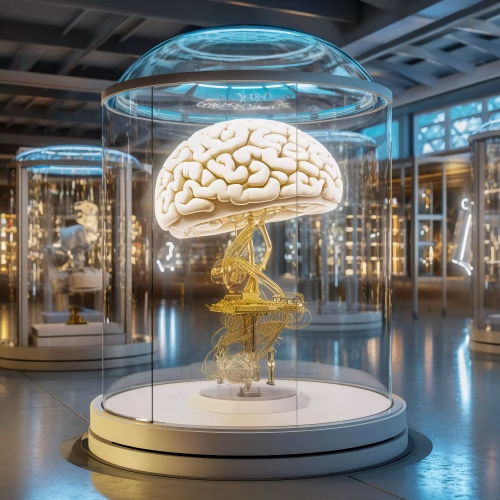
The Foundations: From Synapses to Systems
At its core, neuroscience begins with the fundamental unit of the nervous system: the neuron. These specialized cells communicate through electrical and chemical signals across tiny gaps called synapses. Understanding how these individual synapses function and how they form vast, intricate neural networks is paramount to comprehending the brain's capabilities. Early brain research focused on mapping these structures and understanding basic physiological responses. However, modern neuroscience has evolved to encompass a systems-level approach, examining how different brain regions interact to produce complex behaviors and cognitive functions.
The field of neurology, a branch of medicine focused on disorders of the nervous system, directly benefits from this foundational understanding. Conditions like Alzheimer's, Parkinson's, epilepsy, stroke, and multiple sclerosis, once considered incurable or poorly understood, are now being tackled with increasingly sophisticated approaches, thanks to advancements in our knowledge of neural pathways and cellular mechanisms. This progress underscores the direct and tangible benefits of sustained brain research.
Neuroscience's Ripple Effect: Impact Across Disciplines
The influence of neuroscience extends far beyond the traditional boundaries of medicine and biology. Its insights are permeating numerous sectors, driving innovation and fostering a deeper understanding of human potential and societal challenges.
Advancements in Biotechnology and Neurotechnology
The synergy between neuroscience and biotechnology has given rise to revolutionary neurotechnology. This includes the development of brain-computer interfaces (BCIs) that allow individuals with paralysis to control prosthetic limbs or communicate through thought. Deep brain stimulation (DBS) has become a vital treatment for Parkinson's disease and severe depression, offering relief where other therapies have failed. Cochlear implants restore hearing, and retinal implants offer hope for the visually impaired. These technologies are not just medical interventions; they represent a frontier in human augmentation and rehabilitation, fundamentally altering lives and pushing the boundaries of what is possible.
The Intersection with Artificial Intelligence and Neural Networks
Perhaps one of the most visible societal impacts of neuroscience is its profound influence on artificial intelligence (AI). The architecture of modern AI, particularly deep learning, is heavily inspired by the structure and function of biological neural networks. Concepts like parallel processing, learning through experience, and pattern recognition in AI are direct reflections of principles observed in the human brain. Computational neuroscience plays a critical role here, using mathematical models and simulations to understand brain function, which in turn informs the development of more sophisticated and efficient AI algorithms. This cross-pollination is leading to breakthroughs in areas such as natural language processing, computer vision, and autonomous systems, fundamentally reshaping industries and daily life.
Enhancing Cognitive Science and Education
Cognitive science, the interdisciplinary study of mind and its processes, relies heavily on neuroscience to understand how we learn, remember, perceive, and make decisions. Insights from brain research are transforming educational practices, leading to more effective teaching methodologies tailored to how the brain acquires and retains information. Understanding neuroplasticity – the brain's ability to reorganize itself – opens new avenues for rehabilitation after brain injury and for lifelong learning. This direct application of neuroscience to learning and development has an immense impact of neuroscience on society, fostering a more educated and adaptable populace.
Brain Mapping and Understanding Complex Disorders
The ambitious endeavor of brain mapping, exemplified by initiatives like the Human Brain Project and the BRAIN Initiative, aims to create comprehensive atlases of the brain's connectivity and activity. By mapping neural circuits and understanding their function, scientists can pinpoint the origins of neurological and psychiatric disorders with greater precision. This granular understanding is crucial for developing targeted therapies for conditions like autism, schizophrenia, depression, and addiction. The ability to visualize and analyze the brain at such detailed levels is a testament to the power of modern neuroscience tools and techniques.
Ethical Considerations and the Future of Neuroscience
As neuroscience continues its rapid ascent, it inevitably raises complex ethical questions. Issues surrounding brain privacy, cognitive enhancement, the use of neuroimaging in legal contexts, and the potential for misuse of neurotechnology demand careful consideration. Society must engage in robust discussions to establish ethical guidelines that ensure these powerful advancements are used responsibly and for the benefit of all humanity.
Looking ahead, the future of neuroscience promises even more transformative discoveries. We are on the cusp of truly understanding consciousness, developing personalized treatments based on an individual's unique brain profile, and creating seamless interfaces between the human brain and artificial intelligence. The integration of quantum computing with computational neuroscience could unlock unprecedented insights into brain function. The potential to eradicate debilitating neurological diseases, enhance human capabilities, and even extend healthy cognitive lifespan is within reach.
Deep Science Workshops: Bridging Knowledge to Implementation
To truly harness the immense potential of neuroscience and ensure its positive impact of neuroscience on society, it is crucial to foster a new generation of experts equipped with both theoretical knowledge and practical skills. This is where initiatives like Deep Science Workshops and Deep Science Implementation play a pivotal role. These programs are designed to bridge the gap between fundamental scientific principles and real-world applications, offering immersive learning experiences in cutting-edge areas from basic neuronal function to advanced computational synapses.
By participating in such specialized training, aspiring neuroscientists, biotechnologists, and AI researchers can gain hands-on experience with advanced tools and techniques in brain research, neural networks, and neurotechnology. These workshops provide a unique platform for individuals to delve into the intricacies of cognitive science, understand the complexities of neurology, and contribute to the ongoing efforts in brain mapping. They are essential for cultivating the talent needed to drive future innovations and ensure that the benefits of neuroscience are widely accessible and ethically applied.
The journey into the human brain is perhaps the most challenging and rewarding scientific endeavor of our time. As we continue to unlock its secrets, the impact of neuroscience on society will only grow, promising a future where neurological disorders are curable, human potential is maximized, and our understanding of what it means to be human is profoundly enriched. Embrace this future by exploring the depths of neuroscience.
Join Now