
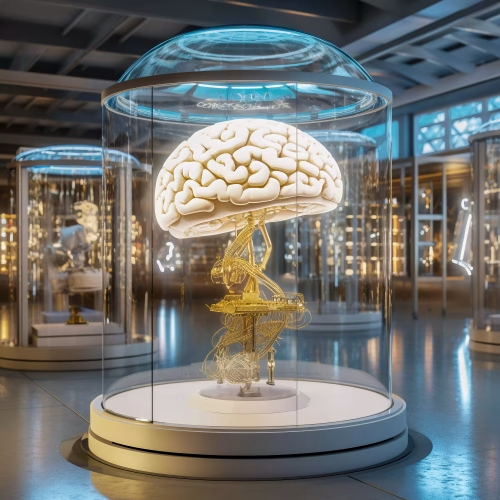
The Brain: Our Ultimate Learning Machine
At the heart of all learning lies the human brain, an organ of unparalleled complexity and adaptability. For centuries, education has operated largely on empirical observations of how people learn. However, with the advent of modern neuroscience, we now possess the tools to peer inside this incredible organ and understand the biological underpinnings of learning. This deeper understanding reveals that the brain is not a static vessel to be filled, but a dynamic, ever-changing landscape shaped by experience. Every new piece of information, every skill acquired, leaves an imprint, subtly altering the neural architecture. This fundamental principle of brain plasticity underscores the importance of creating rich, stimulating learning environments that actively engage the brain's natural capacity for growth and adaptation. Understanding the brain is the first step towards truly transformative education.
Neurons and Synapses: The Microscopic World of Learning
To truly grasp how learning occurs, we must descend to the cellular level, where billions of specialized cells called neurons communicate through electrochemical signals. These signals cross tiny gaps known as synapses. It is at these synaptic junctions that memories are formed and knowledge is consolidated. When we learn something new, existing synaptic connections can strengthen, or entirely new ones can form. This process, often summarized as "neurons that fire together, wire together," is the physical manifestation of learning. Understanding the intricate dance between neurons and synapses provides educators with a powerful framework for designing activities that promote robust neural pathways. For instance, spaced repetition, active recall, and multisensory engagement are all strategies rooted in optimizing synaptic function and strengthening neural networks, thereby enhancing memory and understanding.
Harnessing Neuroplasticity for Enhanced Learning
One of the most profound discoveries in modern neuroscience is neuroplasticity – the brain's remarkable ability to reorganize itself by forming new neural connections throughout life. This means that learning is not limited to childhood; our brains continue to adapt and change in response to new experiences, challenges, and learning opportunities. For education, this concept is revolutionary. It implies that with the right strategies and persistent effort, individuals can develop new skills, overcome learning difficulties, and even recover from brain injuries. Educators can leverage neuroplasticity by encouraging growth mindsets, promoting deliberate practice, and designing curricula that continuously challenge students to build new connections. The implications for lifelong learning and personal development are immense, proving that the capacity for growth is inherent in every human brain.
Cognitive Processes: Attention, Memory, and Executive Functions
Neuroscience provides critical insights into the cognitive processes that underpin effective learning. Attention, for example, is the gateway to learning; without it, information cannot be encoded into memory. Understanding how the brain sustains and shifts attention allows educators to design lessons that capture and maintain student engagement. Similarly, memory, particularly working memory and long-term memory, is central to knowledge acquisition. Neuroscientific research helps us understand how memories are consolidated and retrieved, informing strategies like chunking information, using mnemonics, and providing opportunities for active recall. Furthermore, executive functions – planning, problem-solving, and self-regulation – are crucial for academic success. By understanding the neural circuits involved, educators can develop targeted interventions to strengthen these vital skills, fostering independent and strategic learners.
The Pivotal Role of Biotechnology in Advancing Neuroscience Research
The rapid progress in neuroscience would not be possible without significant advancements in biotechnology. This field provides the cutting-edge tools and techniques necessary to explore the intricate landscape of the brain at unprecedented resolution. From advanced neuroimaging technologies like fMRI and PET scans that allow us to observe brain activity in real-time, to optogenetics and CRISPR gene-editing tools that enable precise manipulation of neurons and their functions, biotechnology is revolutionizing our capacity for research. These innovations allow scientists to unravel the complexities of neurological disorders, understand the genetic basis of learning differences, and even develop novel interventions. The synergy between biotechnology and neuroscience is accelerating discoveries that directly inform and transform educational methodologies, pushing the boundaries of what we know about human cognition and learning.
Genetics and Personalized Learning Paths
While environmental factors and teaching methods play a crucial role, individual differences in learning are also influenced by genetics. Modern research in genetics is beginning to shed light on how specific genetic variations can impact cognitive abilities, learning styles, and even predispositions to certain learning challenges. This doesn't imply a deterministic view, but rather offers a more nuanced understanding of each student's unique profile. Integrating insights from genetics with neuroscience and education allows for the development of truly personalized learning paths. Educators can tailor instructional strategies, provide targeted support, and create environments that best suit each student's inherent strengths and needs. This approach moves away from a one-size-fits-all model, embracing the diversity of human brains and optimizing educational outcomes for every learner.
From Lab to Classroom: Practical Applications
The theoretical insights from neuroscience are increasingly finding practical applications in the classroom. For example, understanding the importance of sleep for memory consolidation encourages educators to advocate for sufficient rest. Knowledge about the impact of stress on the brain informs strategies for creating supportive and low-stress learning environments. Incorporating movement and physical activity, known to enhance cognitive function, is another neuroscientifically informed practice. Furthermore, the principles of spaced learning, interleaving, and retrieval practice are direct applications of how the brain best processes and retains information. These evidence-based strategies, derived from rigorous research in neurology and cognitive science, empower teachers to move beyond intuition and implement methods proven to enhance learning outcomes for all students.
Deep Science Workshops: Bridging the Gap in Neuroscience and Education
Recognizing the immense potential of this interdisciplinary field, initiatives like Deep Science Workshops are at the forefront of translating complex neuroscientific principles into actionable educational strategies. These workshops provide educators, students, and enthusiasts with hands-on experience and in-depth knowledge, ranging from the fundamental principles of neuroscience to the intricacies of computational synapses. They offer a unique opportunity to explore the latest advancements in biotechnology and their applications in understanding the brain. Through practical exercises and expert-led sessions, participants gain a comprehensive understanding of how neurons communicate, how memories are formed, and how this knowledge can be directly applied to optimize learning environments. Deep Science Workshops are designed to empower individuals with the tools and insights needed to foster a new era of brain-informed education.
The Future of Learning: Driven by Deep Science Implementation
The journey from theoretical research to practical application is where the real transformation happens. Deep Science Implementation focuses on integrating these advanced neuroscientific and biotechnological insights into real-world educational settings. This involves developing innovative curricula, training educators in brain-friendly teaching methodologies, and creating learning tools that are grounded in how the brain naturally learns. By focusing on the practical application of neuroscience, we can move towards an educational system that is more efficient, engaging, and equitable. This forward-thinking approach ensures that the discoveries made in the lab, particularly concerning the intricate dance of neurons and the plasticity of the brain, are not confined to academic journals but are actively used to benefit learners globally. The future of education is undoubtedly intertwined with the continued research and implementation of deep scientific principles.
Conclusion: A New Horizon for Learning
The convergence of neuroscience and Education represents a new horizon for human potential. By understanding the fundamental principles of the brain, the intricate communication of neurons and synapses, and the transformative power of neuroplasticity, we can design educational experiences that are truly optimized for learning. The continuous advancements in biotechnology and research in fields like biology, genetics, and neurology further empower us to refine these approaches. Initiatives like Deep Science Workshops and the commitment to Deep Science Implementation are crucial in bridging the gap between scientific discovery and practical application. Embracing this interdisciplinary approach will not only enhance academic achievement but also foster a deeper appreciation for the incredible capacity of the human mind. The future of learning is brain-informed, personalized, and profoundly effective.
Join Now