
The human brain, a marvel of biological engineering, remains one of the most complex and enigmatic structures in the known universe. Its intricate network of neurons and synapses governs everything from our thoughts and emotions to our movements and memories. Understanding this complexity is the core pursuit of neuroscience, a field that bridges biology, chemistry, physics, and computer science. This article delves into the fascinating journey of brain research, exploring its fundamental principles and the cutting-edge advancements in computational neuroscience that are revolutionizing our approach to neurological disorders and their treatment. Join us as we unravel the secrets of the mind, from the microscopic dance of synaptic plasticity to the macroscopic patterns of neural networks.
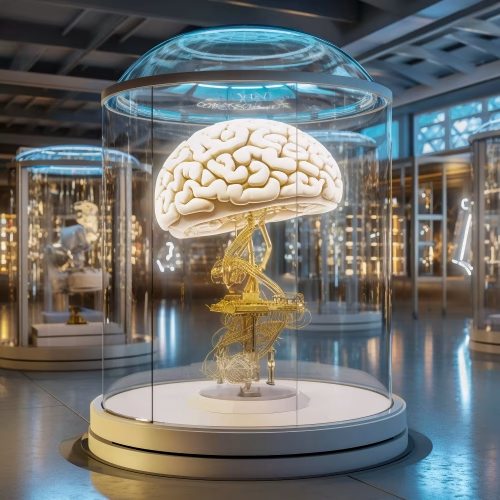
At its most fundamental level, the brain is an electrochemical organ composed of billions of specialized cells. Neurons, the primary communicators, transmit signals across vast distances, forming intricate circuits. Supporting these neurons are glial cells, which provide crucial structural and metabolic support. The precise communication between neurons occurs at junctions called synapses, where neurotransmitters are released, either exciting or inhibiting the next neuron. A key mechanism underlying learning and memory is synaptic plasticity, the ability of these synaptic connections to strengthen or weaken over time. This dynamic adaptability allows our brains to constantly reshape in response to new experiences, forming the very basis of our cognitive abilities. Understanding these foundational principles is paramount for anyone venturing into advanced brain research or seeking to comprehend the complexities of neurological disorders and their treatment.
Beyond individual neurons and synapses, the brain operates through vast and interconnected neural networks. These networks are responsible for everything from simple reflexes to complex decision-making and consciousness. Modern neuroscience increasingly leverages computational models to understand how these networks emerge from the collective activity of individual neurons. The study of these intricate webs helps us decipher how the brain processes information, stores memories, and generates behaviors. From sensory perception to motor control, every function relies on the precise orchestration of these networks. Disruptions within these networks are often at the heart of various neurological disorders, making their study crucial for developing effective interventions. The insights gained here are profoundly influencing fields like artificial intelligence, where artificial neural networks are inspired by their biological counterparts.
Despite remarkable progress in brain research, neurological disorders remain a significant global health challenge. Conditions such as Alzheimer's disease, Parkinson's disease, multiple sclerosis, epilepsy, and stroke impact millions, often leading to severe cognitive and physical impairments. These neurodegenerative diseases pose immense burdens on individuals, families, and healthcare systems. The field of neurology focuses on the diagnosis and initial management of these conditions, striving to alleviate symptoms and improve patient quality of life. However, the complex etiology of many of these disorders, often involving genetic predispositions, environmental factors, and age-related changes, makes their complete understanding and cure a formidable task. This is where the interdisciplinary power of biotechnology and advanced scientific approaches become indispensable.
The landscape of neurological disorders and their treatment is rapidly evolving, driven by breakthroughs in biotechnology and medical science. Traditional pharmacological interventions are being augmented by innovative approaches. Stem cells, with their remarkable ability to differentiate into various cell types, hold immense promise for regenerative medicine, potentially replacing damaged neurons or supporting existing ones in conditions like Parkinson's or spinal cord injuries. Similarly, gene therapy offers the potential to correct genetic defects underlying inherited neurological conditions, providing a targeted approach to disease modification rather than just symptom management. These cutting-edge therapies represent a new frontier in neurology, moving towards more personalized and effective treatments. The integration of these advanced biological tools with a deep understanding of neural networks is key to future successes.
One of the most exciting frontiers in modern brain research is computational neuroscience. This field applies mathematical models, theoretical analysis, and computer simulations to understand the principles governing the nervous system. By creating sophisticated models of neurons, synapses, and entire neural networks, researchers can simulate brain activity, test hypotheses, and predict the effects of various interventions. This computational approach is invaluable for deciphering the complexities of synaptic plasticity and how it contributes to learning and memory, or how disruptions lead to neurodegenerative diseases. From analyzing vast datasets of brain imaging to simulating the effects of new drugs, computational neuroscience provides powerful tools to accelerate our understanding and develop novel strategies for neurological disorders and their treatment. It truly brings the fundamental principles of neuroscience into the realm of practical, simulated computational synapses.
To truly advance the fields of neuroscience and biotechnology, practical, hands-on experience is crucial. This is where initiatives like Deep Science Workshops play a pivotal role. These workshops are designed to provide participants with intensive training in the latest techniques and theoretical frameworks, bridging the gap between academic knowledge and real-world application. Whether it's mastering advanced imaging techniques, understanding data analysis for neural networks, or exploring the intricacies of gene therapy, these programs equip aspiring scientists with the skills needed to contribute meaningfully to brain research. The focus on practical **Deep Science Implementation** ensures that participants are not just learning concepts but are also capable of applying them to solve complex problems in neurology and beyond.
The journey into the brain's mysteries is far from over. The future of brain research promises even more transformative discoveries. Personalized medicine, tailored to an individual's genetic makeup and specific neurological profile, is becoming a reality. Advances in brain-computer interfaces (BCIs) hold the potential to restore function for individuals with severe neurological impairments. Ethical considerations surrounding these powerful technologies are also at the forefront of discussions, ensuring responsible innovation. As we continue to unravel the complexities of neural networks and synaptic plasticity, and as biotechnology provides increasingly sophisticated tools, the hope for more effective prevention, diagnosis, and treatment of neurological disorders and their treatment grows stronger. The synergy between fundamental principles and advanced computational neuroscience will undoubtedly lead to unprecedented breakthroughs, transforming lives and deepening our understanding of what it means to be human.
Join Now