
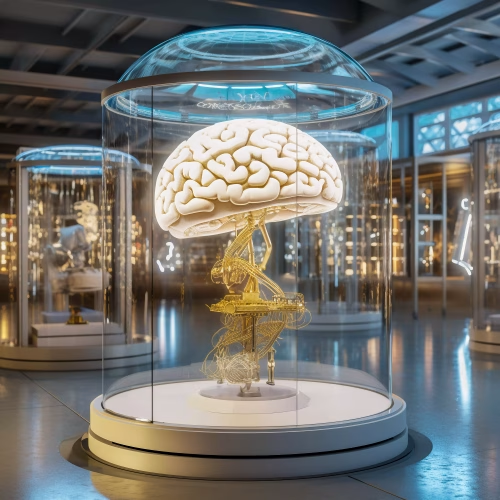
The Brain as a Blueprint: AI's Debt to Neuroscience
The very foundation of modern artificial intelligence, particularly deep learning, rests heavily on principles derived from neuroscience. The concept of neural networks, the backbone of AI's success in areas like image recognition and natural language processing, is a direct abstraction of the brain's interconnected neurons. Each 'neuron' in an artificial network processes input and passes it on, much like its biological counterpart, and the 'weights' between these connections are adjusted through learning, mirroring the strengthening or weakening of a biological synapse. This bio-inspired architecture has allowed AI to tackle problems previously deemed intractable, demonstrating remarkable capabilities in pattern recognition and complex decision-making.
Early pioneers in AI looked to the brain for inspiration, recognizing its unparalleled ability to learn and adapt. While artificial neural networks are vastly simpler than the billions of neurons and trillions of synapses in the human brain, they have proven incredibly powerful. The continuous refinement of these models, often informed by new discoveries in neurobiology and cognitive science, leads to more sophisticated AI systems. For instance, understanding how the brain processes visual information has led to the development of convolutional neural networks (CNNs), which are now ubiquitous in computer vision. Similarly, insights into memory and attention mechanisms in the brain are inspiring new recurrent neural network (RNN) and transformer architectures.
AI's Impact on Unraveling Brain Mysteries
The relationship is reciprocal. Just as neuroscience has informed AI, artificial intelligence is now becoming an indispensable tool for accelerating brain research. The sheer volume and complexity of neuroscientific data—from fMRI scans and EEG recordings to single-cell genomics and connectomics—are overwhelming for traditional analysis methods. This is where AI neuroscience steps in. Machine learning algorithms can identify subtle patterns, predict neural activity, and even help reconstruct complex neural circuits with unprecedented precision. This capability is revolutionizing our ability to diagnose neurological disorders, understand consciousness, and develop targeted therapies.
Computational neuroscience, a field that uses mathematical models and computational simulations to understand the brain, is particularly benefiting from AI. Researchers can now build highly detailed simulations of brain regions, test hypotheses about neural function, and even predict the effects of interventions. This synergy is leading to a deeper understanding of how information is encoded, processed, and stored in the brain, offering new perspectives on everything from perception to decision-making. This is a critical step towards developing truly effective treatments for neurological and psychiatric conditions.
Neurotech and Biotechnology: The Frontier of Application
The practical applications of this convergence are perhaps most evident in the burgeoning field of neurotech. Brain-computer interfaces (BCIs), once the stuff of science fiction, are rapidly becoming a reality, enabling individuals with paralysis to control prosthetic limbs or communicate using only their thoughts. AI algorithms are crucial for decoding neural signals and translating them into actionable commands. This area of biotechnology is poised to revolutionize healthcare, offering new hope for restoring lost functions and enhancing human capabilities.
Beyond BCIs, AI neuroscience is driving innovation in areas like neuroprosthetics, smart implants, and advanced diagnostics. For example, AI-powered analysis of brain imaging can detect early signs of neurodegenerative diseases like Alzheimer's or Parkinson's, long before clinical symptoms appear. In biotechnology, AI is accelerating drug discovery for neurological conditions by predicting molecular interactions and optimizing drug candidates. The ability to model complex biological systems with AI is transforming the way we approach medical challenges, paving the way for personalized medicine and more effective interventions. The future of human augmentation and therapeutic breakthroughs hinges significantly on continued advancements at this intersection.
Challenges and Ethical Considerations
While the potential benefits are immense, the intersection of neuroscience and artificial intelligence also presents significant challenges and ethical dilemmas. Issues of data privacy, algorithmic bias, and the potential misuse of neurotechnologies require careful consideration. As we gain the ability to read and potentially influence brain activity, questions about identity, autonomy, and what it means to be human become paramount. Responsible innovation, guided by robust ethical frameworks, is crucial to ensure that these powerful technologies are developed and deployed for the benefit of all humanity.
Moreover, the complexity of the brain means that even with advanced AI, we are still only scratching the surface of its mysteries. Bridging the gap between simplified artificial neural networks and the nuanced, dynamic biological brain remains a grand challenge. Researchers in computational neuroscience and cognitive science are continuously working to refine models and theories, but the path to a complete understanding is long. Ensuring the safety and ethical implications of widespread neurotech adoption is a collective responsibility that demands interdisciplinary dialogue and proactive policy-making.
The Future is Integrated: Deep Science Workshops
The fusion of neuroscience and artificial intelligence is not just a trend; it's the future of scientific inquiry and technological innovation. It promises to unlock unprecedented insights into the human mind and create intelligent systems that can solve some of the world's most pressing problems. For those eager to be at the forefront of this revolution, gaining expertise in both domains is essential. Whether your interest lies in fundamental brain research, developing cutting-edge neurotech, or exploring the depths of computational neuroscience and neurobiology, the opportunities are boundless.
To truly grasp the intricacies of this field and contribute to its advancements, practical knowledge and hands-on experience are invaluable. This is where specialized programs like those offered by Deep Science Workshops come into play. Their comprehensive courses, such as "Neuroscience: Fundamental Principles to Computational Synapses," are meticulously designed to equip aspiring scientists and engineers with the foundational principles and advanced techniques needed to navigate this complex landscape. Through immersive learning and practical applications, participants gain a profound understanding of how neuroscience and artificial intelligence intertwine, preparing them for impactful careers in this transformative domain. Embrace the future with Deep Science Implementation.
Join NowFrequently Asked Questions (FAQ)
What is the primary focus of the intersection between neuroscience and artificial intelligence?
The primary focus lies in understanding how the brain's biological mechanisms can inspire more advanced AI, and conversely, how AI can accelerate our understanding of complex neural processes, leading to breakthroughs in fields like neurotech and computational neuroscience.
How do neural networks in AI relate to biological neural networks?
Artificial neural networks are computational models inspired by the structure and function of biological neural networks in the brain. While simplified, they mimic how neurons (nodes) connect and process information, forming the foundation for many modern AI applications, especially in deep learning.
What career opportunities are available in AI neuroscience?
Career opportunities in AI neuroscience are rapidly expanding, including roles in brain-computer interface development, neuroprosthetics, computational modeling of brain diseases, AI-driven drug discovery in biotechnology, and research in cognitive science and neurobiology. Expertise in both neuroscience and AI is highly valued.
Why is understanding the synapse crucial for AI neuroscience?
The synapse is the fundamental unit of communication between neurons in the brain. Understanding its plasticity and computational properties is crucial because it provides insights into learning, memory, and information processing in biological systems, which can inspire more efficient and adaptive AI algorithms and neural network architectures.
How can Deep Science Workshops help me learn about this field?
Deep Science Workshops offer specialized programs, such as 'Neuroscience: Fundamental Principles to Computational Synapses,' designed to provide comprehensive knowledge and practical skills at the intersection of neuroscience, biotechnology, and AI. These workshops are ideal for those looking to delve into brain research, computational neuroscience, and advanced neurotech applications.