
The human mind, with its capacity for thought, emotion, and self-awareness, remains one of the most profound mysteries of the universe. At its core lies consciousness, an elusive phenomenon that has captivated philosophers and scientists for centuries. In recent decades, advancements in neuroscience have begun to shed light on the intricate mechanisms underlying this profound state. This journey into the brain's complexities is not just academic; it holds immense promise for breakthroughs in medicine, healthcare, and the very fabric of our understanding of existence. Join us as we delve into the cutting-edge research and transformative insights offered by Deep Science Workshops, providing a unique pathway to explore the fundamental principles of the brain, from basic biology to advanced computational synapses.
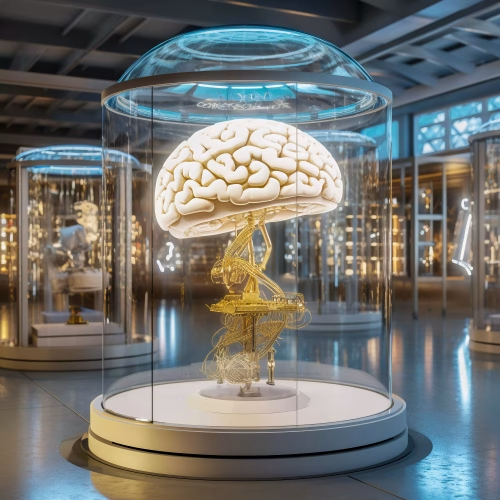
What does it truly mean to be conscious? This question has driven countless investigations across various disciplines. From a neuroscience standpoint, consciousness is not a single entity but an emergent property of complex neural interactions within the brain. It involves the integration of sensory inputs, memories, emotions, and cognitive processes into a unified, subjective experience. Modern research employs sophisticated tools and techniques to map brain activity, identify neural correlates of consciousness, and understand how disruptions in these systems can lead to altered states of awareness.
The quest to understand consciousness is at the forefront of modern science, blending insights from psychology, philosophy, and increasingly, biotechnology. Scientists are exploring theories ranging from integrated information theory, which posits that consciousness arises from a system's capacity to integrate information, to global neuronal workspace theory, suggesting that consciousness emerges when information becomes globally available to various brain regions. These theoretical frameworks are continuously tested and refined through empirical research, pushing the boundaries of what we know about the brain and its incredible capabilities.
At the most fundamental level, the brain is composed of billions of neurons, specialized cells that transmit electrical and chemical signals. These neurons form intricate networks, communicating through junctions called synapses. It is the dynamic interplay within these neural networks that gives rise to all our thoughts, feelings, and actions, including consciousness. Understanding these fundamental principles is crucial for anyone interested in neuroscience.
The field of biology provides the foundational understanding of how these cells develop, function, and interact. Advances in genetics allow scientists to identify specific genes that influence brain development, neuronal connectivity, and susceptibility to neurological disorders. This genetic perspective is vital for personalized medicine and developing targeted therapies. Through dedicated research, we are uncovering how these biological components orchestrate the complex symphony of the mind, paving the way for profound insights into both healthy brain function and the origins of neurological conditions.
The insights gained from studying biological brains are not confined to traditional biology. They are increasingly influencing the realm of technology and artificial intelligence. The concept of "computational synapses" refers to the mathematical models and algorithms that mimic the behavior of biological synapses, forming the building blocks of artificial neural networks. These networks are at the heart of modern AI, driving innovations in machine learning, deep learning, and cognitive computing.
Computational neuroscience is a rapidly expanding field that bridges the gap between biological and artificial intelligence. By simulating brain processes, scientists can test hypotheses about brain function, develop more sophisticated AI systems, and even design brain-computer interfaces. This interdisciplinary approach, often facilitated by advancements in biotechnology, promises to unlock new frontiers in understanding intelligence itself, whether biological or artificial. The implications for science and research are immense, offering new avenues for exploring the very nature of thought and perception.
The practical applications of neuroscience are far-reaching, particularly in the domains of medicine and healthcare. A deeper understanding of brain function is critical for diagnosing, treating, and preventing neurological and psychiatric disorders. Conditions such as Alzheimer's disease, Parkinson's disease, epilepsy, depression, and anxiety affect millions worldwide, and neuroscience research is continuously striving for better interventions.
The pharma industry plays a significant role in translating neuroscience discoveries into new therapeutic drugs. From developing medications that modulate neurotransmitter systems to pioneering gene therapies for neurological conditions, the synergy between neuroscience and pharmaceutical research is vital. Furthermore, advancements in neuro-technology are leading to innovative medical devices, such as deep brain stimulators and neural prosthetics, offering new hope for patients with debilitating conditions. This continuous cycle of discovery and application underscores the critical importance of neuroscience for global health and wellbeing.
For those eager to delve deeper into these fascinating subjects, Deep Science Workshops offer an unparalleled opportunity. Our programs are meticulously designed to provide comprehensive knowledge and practical skills in cutting-edge areas of science and technology, including the intricate world of neuroscience and consciousness. Whether you are a student, a researcher, or a professional looking to expand your expertise, our workshops provide a structured and engaging learning environment.
Through expert-led sessions, hands-on experiments, and discussions on the latest research, participants gain a profound understanding of topics ranging from fundamental brain biology to advanced concepts like computational synapses. We focus on practical Deep Science Implementation, ensuring that the knowledge gained is directly applicable. Our workshops are a perfect blend of theoretical insights and real-world applications, empowering you to contribute to the next wave of innovation in biotechnology, medicine, and healthcare. Don't miss this chance to explore the frontiers of knowledge and unlock your potential in the exciting world of deep science.
The journey to understanding the brain and consciousness is one of the most exciting frontiers in modern science. With every new discovery, we move closer to unraveling the mysteries of the mind, paving the way for a healthier and more insightful future. Embrace this journey with us.
Join Now