
Unlocking the Mind: Exploring the Frontier of Brain-Computer Interfaces
Imagine a world where thought alone can move objects, control complex machinery, or even communicate directly with others. This is not science fiction, but the rapidly evolving reality of Brain-Computer Interfaces (BCIs). At the intersection of neuroscience, engineering, and computer science, BCIs are revolutionizing our understanding of the brain and redefining the boundaries of human capability. This article delves deep into the fascinating realm of BCIs, exploring their fundamental principles, groundbreaking applications, and the ethical considerations that accompany such transformative technology.
The Dawn of Neurotechnology: What Are BCIs?
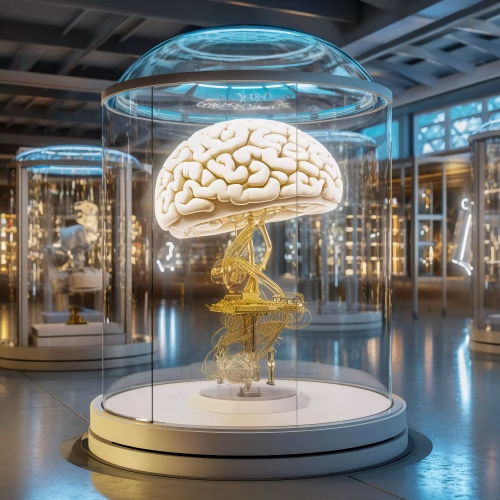
A Brain-Computer Interface (BCI), often referred to as a Brain-Machine Interface (BMI), is a direct communication pathway between an enhanced or wired brain and an external device. Unlike traditional interfaces that rely on peripheral nerves and muscles, BCIs bypass these biological intermediaries, allowing direct control through neural signals. This field is a cornerstone of modern neurotech, pushing the boundaries of what is possible in human-computer interaction. The journey of BCIs began decades ago with rudimentary experiments, but recent advancements in biotechnology research, computational power, and our understanding of the brain have accelerated their development exponentially. It’s a truly interdisciplinary endeavor, bringing together experts in neuroscience, electrical engineering, computer science, and even psychology to unravel the complexities of the human mind and translate its intentions into actionable commands.
How BCIs Work: A Glimpse Inside the Brain
At the heart of every BCI lies the ability to detect and interpret neural activity. Our brains operate through intricate electrical and chemical signals transmitted between neurons via synapse connections, forming vast neural networks. These signals, when aggregated, create measurable electrical patterns. BCIs capture these patterns using various methods:
- Invasive BCIs: These involve surgically implanting electrodes directly into the brain. While highly precise, offering high-resolution data from individual neurons or small groups of neurons, they carry inherent risks of surgery and infection. Examples include neural implants used for prosthetic limb control.
- Non-Invasive BCIs: These do not require surgery and include techniques like Electroencephalography (EEG), which measures electrical activity from the scalp. While less precise than invasive methods, non-invasive BCIs are safer and more accessible, making them suitable for a wider range of applications, from gaming to assistive technologies.
- Partially Invasive BCIs: These sit on the surface of the brain, under the skull, offering a compromise between precision and invasiveness.
Once brain signals are acquired, they undergo sophisticated signal processing. Noise is filtered out, and algorithms are applied to extract meaningful features. Machine learning models are then trained to recognize specific patterns associated with intended actions or thoughts. This process often involves extensive brain mapping to understand which areas of the brain are activated during certain cognitive tasks. The more refined the algorithms and the better the signal quality, the more accurate and responsive the brain computer interface becomes.
Transformative Applications of Brain-Computer Interfaces
The potential applications of Brain-Computer Interfaces are vast and truly transformative, particularly in the medical field. For individuals with severe motor disabilities, such as those suffering from paralysis due to spinal cord injuries or neurodegenerative diseases, BCIs offer a renewed sense of independence. They can control advanced neuroprosthetics, enabling them to move robotic limbs with their thoughts, operate wheelchairs, or even type on a screen using only their minds. This restoration of function is a profound testament to the power of neural interfaces.
Beyond motor control, BCIs are being explored for treating neurological disorders. For instance, deep brain stimulation (DBS), a form of BCI, is already used to manage symptoms of Parkinson's disease and essential tremor. Research is also underway to use BCIs for seizure detection and prevention in epilepsy, and even for restoring memory function in patients with Alzheimer's disease. The insights gained from cognitive science are crucial in designing these therapeutic interventions.
The applications extend far beyond medicine. In the realm of human augmentation, BCIs could enhance cognitive abilities, improve focus, or enable seamless interaction with digital environments. Imagine controlling video games with your thoughts, navigating virtual reality worlds with unprecedented immersion, or even communicating silently through direct brain-to-brain interfaces. While still in early stages, the possibilities are tantalizing and are driving significant biotechnology research.
The Ethical Landscape and Future Challenges
As with any powerful technology, the rise of Brain-Computer Interfaces brings with it a complex array of ethical considerations. Questions surrounding data privacy and security of brain activity are paramount. Who owns the neural data collected by BCIs? How can we ensure it's not misused or accessed without consent? The potential for "brain hacking" or unauthorized manipulation of thoughts raises serious concerns about individual autonomy and mental privacy.
Furthermore, the prospect of human augmentation through BCIs sparks debates about identity, equity, and accessibility. Will these advanced technologies create a new divide between those who can afford enhancements and those who cannot? Ensuring responsible development, equitable access, and robust regulatory frameworks are crucial to navigate these challenges. The field of neuroscience is not just about scientific discovery, but also about societal responsibility.
The future of BCIs holds immense promise. Researchers are working towards higher-resolution interfaces, wireless systems, and bidirectional BCIs that can not only read but also write information to the brain, potentially enabling sensory restoration or even memory recall. The integration of artificial intelligence with neural networks will further refine the capabilities of these systems, making them more intuitive and powerful.
Deepening Your Understanding with Deep Science Workshops
The world of neuroscience and Brain-Computer Interfaces is constantly evolving, presenting exciting opportunities for learning and innovation. If you are passionate about understanding the fundamental principles of the brain, from the intricacies of a synapse to the complex architecture of neural networks, and eager to explore cutting-edge biotechnology research, then Deep Science Workshops and Deep Science Implementation programs are designed for you. These programs provide hands-on experience and in-depth knowledge, bridging the gap between theoretical understanding and practical application in the field of neurotech.
Whether you are a student, researcher, or simply a curious mind, engaging with structured learning environments can provide the foundational knowledge and practical skills necessary to contribute to this revolutionary domain. Explore the depths of cognitive science and the mechanics of neural interfaces with expert guidance.
Conclusion
Brain-Computer Interfaces represent one of the most exciting and impactful frontiers in modern science and technology. By forging a direct link between the human mind and external devices, they offer unprecedented possibilities for restoring lost function, treating neurological conditions, and potentially augmenting human capabilities. While challenges related to ethics, privacy, and technical refinement remain, the ongoing advancements in neuroscience, biotechnology research, and neurotech promise a future where the power of thought can truly unlock new realities. The journey into the human brain and its interface with technology is just beginning, and its implications for humanity are profound.