
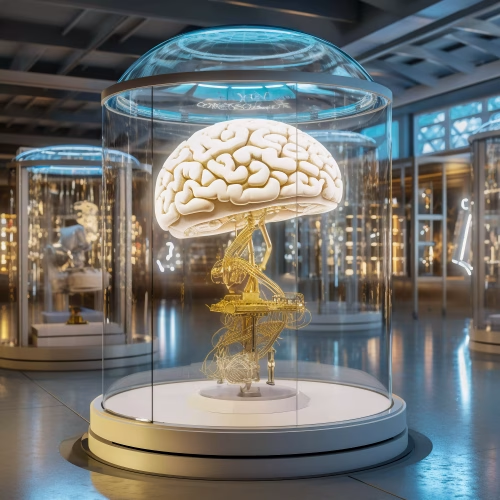
The Symbiotic Relationship: Neuroscience Meets Psychology
At its core, neuroscience is the scientific study of the nervous system, focusing on the structure, function, development, genetics, biochemistry, physiology, pharmacology, and pathology of the nervous system. It delves into the cellular and molecular mechanisms that underpin all mental processes. Psychology, conversely, is the scientific study of mind and behavior. While traditionally distinct, modern advancements in imaging, genetic analysis, and computational modeling have blurred the lines, creating a rich interdisciplinary landscape. This synergy allows researchers to investigate how biological mechanisms give rise to complex psychological phenomena, from memory formation and decision-making to emotional regulation and social interaction. It’s a holistic approach that recognizes the inseparable link between the biological substrate and the psychological experience.
Decoding the Brain: From Neurons to Cognitive Functions
The fundamental unit of the nervous system is the neuron, a specialized cell that transmits electrical and chemical signals. Trillions of these cells form intricate networks, communicating across tiny gaps called synapses. These synaptic connections are the bedrock of all brain activity, enabling everything from simple reflexes to abstract thought. Understanding how these neurons fire, how their connections strengthen or weaken, and how they organize into functional circuits is central to both neuroscience and cognitive psychology. Researchers employ advanced techniques to map neural pathways, observe real-time brain activity, and even manipulate specific neural circuits to understand their role in various behaviors. This deep dive into the micro-level helps explain macro-level phenomena like learning, attention, and problem-solving, bridging the gap between molecular biology and complex human behavior.
The Role of Biotechnology in Advancing Brain Research
The rapid evolution of biotechnology has been a game-changer for neuroscience research. Cutting-edge tools and methodologies have revolutionized our ability to study the brain with unprecedented precision. Techniques like optogenetics allow scientists to control neuron activity with light, while CRISPR gene editing offers the ability to modify genes associated with neurological disorders. Advanced neuroimaging techniques such as fMRI (functional Magnetic Resonance Imaging) and EEG (Electroencephalography) provide non-invasive ways to visualize brain activity in real-time, offering insights into cognitive processes and emotional states. Furthermore, the development of sophisticated computational models and brain-computer interfaces (BCIs) is propelling the field towards understanding and potentially augmenting human capabilities. Biotechnology is not just observing the brain; it's enabling us to interact with it, understand its pathologies, and develop innovative therapies for conditions ranging from Alzheimer's to depression.
From Fundamental Principles to Computational Synapses
The journey from understanding the fundamental principles of neural communication to developing computational models of the brain is a testament to interdisciplinary progress. Computational neuroscience, a subfield at the intersection of neuroscience, science, and computer science, uses mathematical models and theoretical analysis to understand the principles that govern the development, structure, physiology, and cognitive abilities of the nervous system. This involves simulating individual neurons, entire neural networks, and even complex brain regions. The concept of computational synapses is particularly exciting, as it allows researchers to build artificial systems that mimic the learning and adaptive capabilities of biological brains. These models are invaluable for testing hypotheses, predicting behavior, and designing new AI architectures inspired by the efficiency and robustness of the human brain. This area of research holds immense promise for both artificial intelligence and therapeutic interventions in neurology.
Addressing Neurological and Psychological Disorders
The integrated understanding gained from the convergence of neuroscience and psychology is crucial for addressing a wide spectrum of neurological and psychological disorders. Conditions like depression, anxiety, schizophrenia, Parkinson's disease, and Alzheimer's disease are increasingly understood through the lens of both brain biology and psychological experience. Research in this area aims to identify biomarkers, develop targeted pharmacological interventions, and create more effective psychological therapies. For instance, understanding the neural circuits involved in mood regulation can lead to better treatments for depression, while insights into synaptic dysfunction can inform strategies for neurodegenerative diseases. The goal is to move beyond symptomatic treatment to address the root causes of these debilitating conditions, improving the quality of life for millions worldwide. This requires continuous research and implementation of new findings.
The Future of Brain Science: Deep Learning and Beyond
The future of brain science is incredibly promising, with advancements in areas like deep learning and artificial intelligence drawing heavily from principles of neuroscience. Concepts like neural networks, which power much of modern AI, are directly inspired by the architecture of the human brain. As our understanding of biological neurons and synapses deepens, so too will the sophistication of artificial intelligence. Furthermore, the ethical considerations surrounding brain interfaces and neuro-enhancement are becoming increasingly important, necessitating a thoughtful approach to the implementation of new technologies. The continuous dialogue between neuroscience, psychology, biotechnology, and computer science will undoubtedly lead to breakthroughs that redefine our understanding of what it means to be human and how we interact with technology.
For those passionate about delving deeper into these complex and rewarding fields, comprehensive training and practical experience are invaluable. Programs that offer a blend of theoretical knowledge and hands-on application are essential for future innovators. This is where initiatives like Deep Science Workshops and Deep Science Implementation come into play, providing platforms for immersive learning and practical skill development in cutting-edge areas of brain science.
Join NowFrequently Asked Questions about Neuroscience and Psychology
What is the primary difference between neuroscience and psychology?
While both fields study the mind and behavior, neuroscience primarily focuses on the biological and physiological aspects of the nervous system, including the brain, neurons, and their functions. Psychology, on the other hand, broadly investigates mental processes and behavior, encompassing cognitive, emotional, and social aspects, often without direct emphasis on the underlying biology, though cognitive neuroscience bridges this gap.
How does biotechnology contribute to neuroscience research?
Biotechnology provides invaluable tools and techniques for neuroscience research. This includes genetic engineering for studying neural circuits, advanced imaging techniques like fMRI and optogenetics for observing brain activity, and the development of novel therapies for neurological disorders. It enables deeper insights into cellular and molecular mechanisms of the brain.
What are computational synapses, and why are they important?
Computational synapses refer to models or simulations of synaptic connections within artificial neural networks or computational models of the brain. They are crucial for understanding how information is processed and stored in neural circuits, for developing AI systems inspired by biological brains, and for simulating neurological conditions to test potential treatments. They represent a key intersection of neuroscience and computational science.
Who can benefit from Deep Science Workshops in Neuroscience?
Deep Science Workshops in neuroscience are designed for students, researchers, and professionals in fields like biotechnology, neurology, psychology, computer science, and related disciplines. Anyone eager to gain a fundamental understanding of brain function, explore advanced research methodologies, or delve into computational aspects of the brain will find these workshops highly beneficial for their academic and career growth.