
The human brain, an enigma of unparalleled complexity, continues to be the most fascinating frontier of scientific exploration. For centuries, scientists have sought to unravel its mysteries, from the intricate dance of a single neuron to the vast networks that underpin consciousness, memory, and emotion. Today, the field of neuroscience stands on the precipice of a new era, driven by groundbreaking advancements in biotechnology, computational power, and interdisciplinary research. This article delves into the exciting future directions of neuroscience research, highlighting how cutting-edge techniques and innovative thinking are poised to revolutionize our understanding of the brain and pave the way for unprecedented therapeutic interventions. As we push the boundaries of what's possible, the convergence of various scientific disciplines is accelerating our journey towards deciphering the brain's ultimate secrets, transforming our approach to health, disease, and human potential.
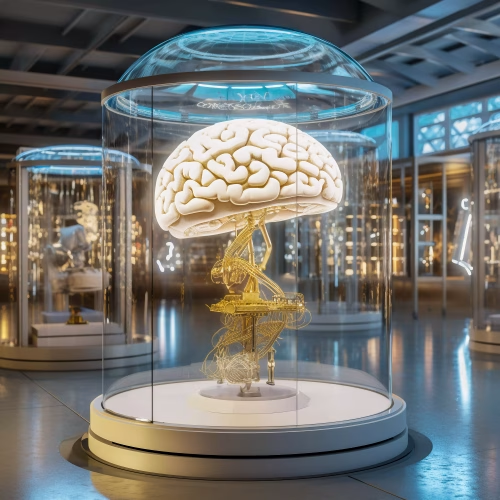
One of the most transformative future directions in neuroscience research is the increasing integration of computational models and artificial intelligence (AI). The sheer volume and complexity of brain data generated by modern experimental techniques necessitate powerful analytical tools. Computational neuroscience leverages algorithms and machine learning to build sophisticated models of neural circuits, predict brain activity, and simulate the intricate functions of a synapse. These models range from detailed simulations of individual neuron behavior to large-scale network models that shed light on cognitive processes. AI-driven data analysis is accelerating the discovery of patterns in complex datasets, identifying biomarkers for neurological disorders, and even designing novel experiments. The ability to simulate and predict brain function computationally is not only advancing our fundamental understanding but also offering new avenues for developing targeted therapies and understanding the mechanisms of learning and memory. This synergy between biology and computation is redefining the landscape of brain science.
The ability to visualize the living brain with increasing resolution and specificity is paramount to advancing neurology. Future directions in neuroimaging include ultra-high field MRI, functional near-infrared spectroscopy (fNIRS), and advanced PET imaging, which promise unprecedented insights into brain structure and activity. These technologies are being refined to detect subtle changes associated with early-stage neurological diseases, monitor treatment efficacy, and even map individual neural pathways with remarkable precision. Beyond mere visualization, the integration of these imaging modalities with AI and machine learning will enable more accurate and earlier diagnoses of conditions like Alzheimer's, Parkinson's, and psychiatric disorders. The goal is to move towards personalized diagnostic approaches, where imaging data, combined with genetic and clinical information, provides a comprehensive picture of an individual's brain health, enabling proactive and tailored interventions. This area of research is critical for translating scientific discoveries into tangible patient benefits.
Brain-computer interfaces (BCIs) represent a frontier with immense potential, promising to restore function for individuals with severe neurological impairments and to augment human capabilities. The future of BCIs involves developing more seamless, high-bandwidth, and minimally invasive interfaces. Advances in material science and nanotechnology are leading to biocompatible implants that can record and stimulate neural activity with greater precision and stability. These technologies are not only aimed at restoring motor function or communication for paralyzed individuals but also at treating conditions like epilepsy, depression, and chronic pain by modulating specific brain circuits. The ethical considerations surrounding human augmentation and data privacy are also a significant part of this future direction, requiring careful societal deliberation alongside technological development. The concept of a computational synapse, where artificial intelligence interacts directly with biological neural networks, is slowly moving from science fiction to a tangible area of research, pushing the boundaries of what it means to be human.
The advent of gene editing technologies like CRISPR-Cas9 has opened new doors for understanding and treating neurological disorders at their root cause. Future neuroscience will increasingly leverage these tools to correct genetic mutations responsible for conditions such as Huntington's disease or certain forms of epilepsy. Beyond gene editing, optogenetics and chemogenetics allow scientists to precisely control the activity of specific neuron populations using light or designer drugs, offering unprecedented control over neural circuits. This level of precision is revolutionizing our understanding of how individual cells and circuits contribute to complex behaviors and pathological states. The integration of these molecular tools with advanced imaging and behavioral assays is enabling researchers to dissect the intricate mechanisms of brain function and dysfunction, paving the way for highly targeted gene therapies and cell-based treatments that can effectively "rewire" the brain for better health. This foundational research is vital for future breakthroughs.
The future of neuropharmacology is moving beyond broad-spectrum drugs towards highly targeted, personalized treatments. Understanding the genetic and molecular underpinnings of individual patients' neurological conditions will allow for the development of drugs that act on specific pathways or even specific cell types. This shift is driven by advancements in pharmacogenomics, which analyzes how an individual's genes affect their response to drugs. Furthermore, the development of novel drug delivery systems that can bypass the blood-brain barrier more effectively will enhance the efficacy of treatments for brain disorders. The goal is to minimize side effects while maximizing therapeutic benefits, leading to more effective and safer interventions for a wide range of neurological and psychiatric conditions. This personalized approach to medicine, deeply rooted in advanced biotechnology, represents a significant leap forward in neurology.
It is clear that biotechnology is not merely an adjunct but a central driving force in the future of neuroscience research. From developing sophisticated tools for single-cell analysis and high-throughput screening to engineering advanced neural probes and therapeutic viral vectors, biotechnology provides the essential toolkit for discovery. Innovations in synthetic biology are enabling the creation of novel biological sensors and actuators that can interact with neural circuits with unprecedented precision. The rapid evolution of bioinformatics and computational biology, deeply intertwined with biotechnology, allows for the processing and interpretation of massive biological datasets, accelerating the pace of discovery. Without the continuous advancements in biotechnology, many of the exciting future directions discussed – from understanding the intricate workings of a synapse to developing complex brain-computer interfaces – would remain theoretical. It is the practical application of biological principles that truly unlocks the potential of brain science.
While the future of neuroscience is bright, it is not without its challenges. The inherent complexity of the brain, with its billions of neurons and trillions of connections, remains a formidable hurdle. Integrating data from disparate sources, developing truly comprehensive models, and translating laboratory findings into effective clinical treatments are ongoing challenges. Furthermore, as our capabilities to manipulate and understand the brain grow, so do the ethical considerations. Questions surrounding privacy of brain data, the implications of neural enhancement, and the definition of consciousness in the age of advanced AI and BCIs require careful deliberation. Ensuring equitable access to new neuro-technologies and establishing robust regulatory frameworks will be crucial as this field continues to evolve. Open dialogue among scientists, ethicists, policymakers, and the public is essential to navigate these complex ethical frontiers responsibly and ensure that advancements in brain research benefit all of humanity.
The rapid advancements in neuroscience and biotechnology are creating unprecedented opportunities for those passionate about understanding the brain. To truly grasp the future directions of neuroscience research, from fundamental principles to the intricacies of computational synapses, specialized knowledge and practical skills are essential. Deep Science Workshops and Deep Science Implementation programs are designed to equip aspiring scientists, researchers, and professionals with the expertise needed to thrive in this dynamic field. Our comprehensive courses provide in-depth insights into cutting-edge techniques, theoretical frameworks, and real-world applications, ensuring you are at the forefront of this scientific revolution. Whether you are looking to deepen your understanding of neurology, contribute to groundbreaking research, or simply explore the wonders of the brain, our programs offer a unique pathway to success. Join our community and be part of shaping the future of brain science.
Join NowWhat are the most promising future directions in neuroscience research?
The most promising future directions in neuroscience research include advanced neuroimaging, brain-computer interfaces (BCIs), optogenetics, personalized neuropharmacology, and the integration of artificial intelligence and machine learning for computational modeling of the brain. These areas are rapidly expanding our understanding of brain function and dysfunction.
How is biotechnology influencing the future of neuroscience?
Biotechnology is a cornerstone of modern neuroscience, enabling breakthroughs in gene editing (CRISPR), advanced microscopy, development of novel therapeutic agents, and the creation of sophisticated tools for neural recording and stimulation. It's driving the ability to manipulate and observe neural circuits with unprecedented precision, accelerating both basic research and clinical applications.
What role do computational models play in understanding the brain?
Computational models are crucial for synthesizing vast amounts of data and simulating complex brain processes. They allow researchers to test hypotheses about neural networks, understand information processing, and predict brain behavior, from the level of individual neurons and synapses to entire cognitive functions. This approach is fundamental to deciphering the brain's intricate computational logic.
Where can I learn more about the fundamental principles to computational synapses in neuroscience?
To delve deeper into the fundamental principles of neuroscience and explore topics like computational synapses, consider enrolling in specialized programs or workshops. Deep Science Workshops offer comprehensive courses designed to provide in-depth knowledge and practical skills in this rapidly evolving field, bridging theoretical understanding with real-world applications.