
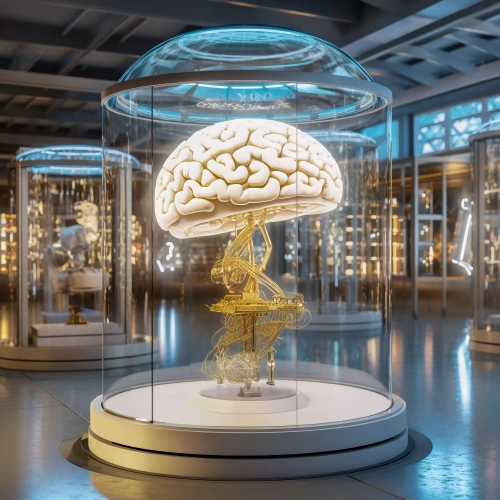
Neuroscience: The Biological Blueprint of the Mind
At its core, neuroscience is the scientific study of the nervous system. This vast field encompasses the anatomy, physiology, biochemistry, and molecular biology of neurons and neural circuits. Researchers in this domain investigate how these biological components give rise to complex functions, from basic reflexes to intricate thought processes. Key areas of focus include understanding the structure of the brain, the function of individual neurons, and how they communicate through electrical and chemical signals across the synapse. Breakthroughs in this field have been instrumental in advancing our understanding of neurological disorders like Alzheimer's and Parkinson's, as well as mental health conditions. Modern brain research heavily relies on sophisticated tools, including advanced microscopy, genetic manipulation, and electrophysiology, providing unprecedented insights into the brain's fundamental operations. The development of new techniques in biotechnology has further propelled this exploration, allowing for more precise manipulation and observation of neural activity.
Cognitive Science: Decoding the Mind's Architecture
While neuroscience focuses on the 'hardware' of the brain, cognitive science is concerned with the 'software' – the mental processes that enable us to perceive, learn, remember, think, and communicate. It is an interdisciplinary field drawing from psychology, linguistics, artificial intelligence, philosophy, and increasingly, neuroscience. This discipline seeks to understand the nature of intelligence and how cognitive functions operate. For instance, how do we recognize faces? How do we form memories? What are the mechanisms behind language acquisition and problem-solving? Early models in cognitive science often drew analogies to computers, viewing the mind as an information-processing system. However, as our understanding of the brain has deepened, this field has increasingly integrated neuroscientific findings to build more biologically plausible models of cognition. This synergy is vital for a holistic understanding of the mind-brain relationship.
The Interplay: Where Minds Meet Brains
The true power of studying the brain lies in the seamless integration of neuroscience and cognitive science. This convergence has led to the emergence of fields like cognitive neuroscience, which directly investigates the neural bases of cognitive processes. For example, understanding how memory works at a cognitive level (e.g., short-term vs. long-term memory) is greatly enhanced by knowing the underlying neural circuits and synaptic plasticity mechanisms identified by neuroscience. Similarly, insights from cognitive science provide a framework for neuroscientists to ask targeted questions about brain function. This symbiotic relationship is evident in various research areas:
- Memory Formation: How do changes at the synapse level contribute to the encoding and retrieval of memories?
- Decision Making: What are the neural correlates of evaluating choices and making decisions, and how do biases influence these processes?
- Language Processing: How are linguistic structures represented in the brain, and what are the neural mechanisms for understanding and producing speech?
- Perception: How does the brain construct our perception of the world from sensory inputs, and what role do top-down cognitive processes play?
Key Research Areas and Tools Bridging the Divide
The advancement of technology has been a crucial catalyst in bridging these two fields. Modern brain research heavily relies on sophisticated tools:
- Neuroimaging Techniques: Tools like fMRI (functional Magnetic Resonance Imaging), EEG (Electroencephalography), and MEG (Magnetoencephalography) allow researchers to observe brain activity in real-time during cognitive tasks. Neuroimaging provides critical insights into which brain regions are active during specific cognitive processes, thereby linking cognitive functions to their neural substrates. This is a cornerstone of modern brain mapping efforts.
- Computational Neuroscience: This field uses mathematical models, simulations, and theoretical analysis to understand the principles of brain function. By creating models of individual neurons, neural networks, or entire brain systems, computational neuroscience helps predict and explain cognitive phenomena, providing a quantitative framework for understanding how information is processed in the brain. It's where the abstract models of cognitive science meet the biological realities of neuroscience.
- Neurotechnology: Advances in neurotechnology, often stemming from biotechnology, are revolutionizing how we interact with the nervous system. This includes brain-computer interfaces (BCIs), optogenetics, and advanced prosthetics. These technologies not only offer therapeutic potential but also serve as powerful research tools, allowing scientists to manipulate neural activity and observe the resulting cognitive and behavioral changes. Understanding the intricate mechanisms of the synapse is paramount in developing effective neurotechnological interventions.
Future Directions and Applications: The Horizon of Brain Understanding
The ongoing collaboration between neuroscience and cognitive science promises to unlock unprecedented insights into the human mind. Future directions include developing more precise brain mapping techniques, creating more sophisticated neural networks for AI that mimic biological brains, and advancing neurotechnology for therapeutic and augmentative purposes. This interdisciplinary approach is crucial for addressing some of humanity's most pressing challenges, from treating neurological and psychiatric disorders to optimizing learning and developing truly intelligent machines. The integration of biotechnology within these fields is accelerating the pace of discovery, enabling novel approaches to understanding and manipulating brain function.
The insights gained from this combined effort are not confined to academic research. They have profound implications for various sectors:
- Medicine: Developing new treatments for cognitive impairments, neurodegenerative diseases, and mental health conditions.
- Education: Designing more effective learning strategies based on how the brain processes and retains information.
- Artificial Intelligence: Building more human-like AI systems by drawing inspiration from biological neural networks and cognitive architectures.
- Human-Computer Interaction: Creating more intuitive and brain-friendly interfaces and technologies.
Empowering the Next Generation of Brain Scientists with Deep Science Workshops
Understanding the intricate relationship between neuroscience and cognitive science is essential for anyone aspiring to contribute to the future of brain research. Programs like Deep Science Workshops and Deep Science Implementation are at the forefront of educating and empowering the next generation of scientists and engineers in these critical fields. They offer comprehensive training that spans from the fundamental principles of neural biology to advanced topics in computational neuroscience and neuroimaging. By providing hands-on experience and cutting-edge knowledge, these workshops equip participants with the skills necessary to navigate the complex landscape of brain science and contribute to groundbreaking discoveries. Whether your interest lies in the microscopic world of the synapse or the macroscopic mapping of the entire brain, Deep Science Workshops provides the platform for deep learning and practical application in biotechnology.
Frequently Asked Questions (FAQ)
What is the primary difference between neuroscience and cognitive science?
Neuroscience primarily focuses on the biological and physiological aspects of the nervous system, including the brain, neurons, and their chemical interactions (like at the synapse). Cognitive science, on the other hand, studies mental processes such as perception, memory, language, and problem-solving, often from an information-processing perspective. While distinct, they are highly complementary, with cognitive neuroscience bridging the gap by studying the neural bases of cognitive functions.
How do neuroimaging techniques contribute to brain research?
Neuroimaging techniques like fMRI, EEG, and MEG allow scientists to non-invasively observe brain activity. They are crucial for brain research because they help identify which brain regions are involved in specific cognitive tasks (e.g., memory recall, language comprehension), thereby linking mental processes to their physical locations and activities within the brain. This is vital for brain mapping and understanding how different parts of the brain contribute to cognition.
What is the role of computational neuroscience in understanding the brain?
Computational neuroscience uses mathematical models and computer simulations to understand how the brain processes information. It helps researchers test hypotheses about neural mechanisms, predict brain behavior, and build theoretical frameworks for understanding complex phenomena like learning and memory. By simulating neural networks, it bridges the gap between the biological details of neuroscience and the abstract models of cognitive science, providing insights into how computations arise from brain activity.
How does Deep Science Workshops contribute to these fields?
Deep Science Workshops and Deep Science Implementation offer specialized training programs that cover fundamental principles of neuroscience, advanced topics in computational neuroscience, and practical applications in neurotechnology and biotechnology. They aim to equip students and professionals with the knowledge and skills required to conduct cutting-edge brain research, understand complex neural networks, and contribute to innovations in areas like neuroimaging and the study of the synapse.