
Unveiling Tomorrow's Brain: Exploring the Future Directions of Neuroscience Research
The human brain, an organ of unparalleled complexity, remains one of the greatest frontiers in scientific inquiry. For centuries, scientists have strived to unravel its mysteries, from the intricate dance of neurons and synapses to the genesis of consciousness and complex thought. Today, we stand on the cusp of a new era in neuroscience, propelled by groundbreaking advancements in biotechnology, artificial intelligence, and innovative research methodologies. This article delves into the most exciting and transformative future directions of neuroscience research, highlighting how these developments are reshaping our understanding of the mind and paving the way for revolutionary treatments and technologies. Prepare to explore a world where the boundaries of what's possible are constantly being redefined, where the synergy of diverse fields is unlocking unprecedented insights into the very essence of what makes us human. Join us as we journey into the future of brain discovery, a future brimming with potential for both scientific enlightenment and profound societal impact.
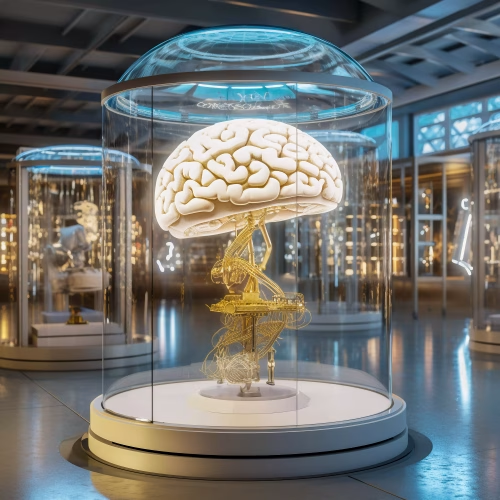
The Dawn of Neurotechnology and AI Integration
One of the most thrilling future directions of neuroscience research lies at the intersection of neurotech and artificial intelligence. Brain-Computer Interfaces (BCIs), once the realm of science fiction, are rapidly becoming a reality, offering unprecedented ways to interact with the nervous system. From restoring motor function in paralyzed individuals to enhancing human capabilities, BCIs are transforming lives. This field is heavily reliant on advanced biotechnology, enabling the creation of sophisticated implants and sensors that can accurately read and interpret brain signals. Furthermore, AI neuroscience is revolutionizing how we analyze the immense datasets generated by brain activity. Machine learning algorithms can identify patterns in neural networks that are imperceptible to the human eye, leading to a deeper understanding of cognitive processes and neurological disorders. The integration of AI allows for predictive modeling of disease progression, personalized treatment strategies, and even the development of 'digital twins' of the brain for experimental simulations. This synergy between human ingenuity and artificial intelligence promises to accelerate the pace of discovery in neuroscience exponentially.
Unraveling the Synaptic Code: Advanced Research Techniques
At the heart of brain function lies the synapse, the tiny junction where neurons communicate. Understanding the intricacies of synaptic transmission is crucial for deciphering how memories are formed, how we learn, and what goes awry in neurological and psychiatric conditions. The future directions of neuroscience research are increasingly focused on high-resolution imaging techniques and molecular tools that allow scientists to visualize and manipulate individual synapses in real-time. Optogenetics, for instance, uses light to control genetically modified neurons, offering unprecedented precision in studying neural circuits. Alongside this, advanced electron microscopy and cryo-electron tomography are providing atomic-level views of synaptic structures, revealing new targets for therapeutic intervention. This fundamental research into the micro-architecture and dynamics of the brain is essential for developing effective treatments for diseases like Alzheimer's, Parkinson's, and epilepsy. The ability to precisely map and modify neural connections holds immense promise for restoring function and even enhancing brain capabilities, pushing the boundaries of what we thought possible in neurobiology.
Cognitive Neuroscience and Mental Health Innovations
The realm of cognitive neuroscience is experiencing a renaissance, driven by new tools and a deeper appreciation for the complex interplay between brain function and mental health. Future research will increasingly focus on understanding the neural correlates of consciousness, decision-making, emotion, and social interaction. This involves combining neuroimaging with behavioral studies and computational modeling to build comprehensive maps of cognitive processes. Critically, these insights are directly translating into innovative approaches for mental health. Personalized psychiatry, guided by an individual's unique brain activity patterns and genetic predispositions, is emerging as a powerful paradigm. Novel therapeutic interventions, including targeted neuromodulation techniques like transcranial magnetic stimulation (TMS) and deep brain stimulation (DBS), are being refined to treat conditions such as severe depression, OCD, and PTSD. The integration of virtual reality (VR) and augmented reality (AR) with neurofeedback is also showing promise for rehabilitation and therapy. This holistic approach, combining cutting-edge neuroscience with psychological principles, offers hope for millions suffering from brain-related disorders, marking a significant step forward in mental healthcare.
The Role of Biotechnology in Accelerating Discovery
Biotechnology is not merely an adjunct to neuroscience; it is a foundational pillar driving its most significant advancements. From CRISPR-Cas9 gene editing technology, which allows for precise modification of genes implicated in neurological disorders, to the development of sophisticated biosensors for detecting disease biomarkers, biotechnology provides the essential tools for groundbreaking inquiry. The ability to create human brain organoids – miniature, self-organizing 3D tissue cultures that mimic aspects of the human brain – has revolutionized drug discovery and disease modeling, offering ethical and efficient alternatives to animal testing. Furthermore, advancements in proteomics and metabolomics, enabled by cutting-edge biotechnological platforms, are providing unprecedented insights into the molecular mechanisms underlying brain function and dysfunction. This synergy ensures that as our understanding of the brain grows, so too does our capacity to intervene effectively. The continuous evolution of biotechnology promises a future where the most challenging neurological conditions may finally yield to targeted, effective therapies, fundamentally altering the landscape of medical science and human well-being.
Ethical Considerations and Societal Impact
As neuroscience research pushes the boundaries of human knowledge and capability, it inevitably raises profound ethical questions. The future directions of neuroscience research must navigate these complexities responsibly. Issues such as privacy of brain data, the potential for cognitive enhancement, neuro-rights, and the equitable access to advanced neurotech solutions require careful consideration. The ability to decode thoughts or manipulate emotions, while offering therapeutic potential, also presents significant societal challenges that demand robust ethical frameworks and public discourse. Organizations and researchers in neuroscience are increasingly engaging with bioethicists, policymakers, and the public to ensure that advancements are used for the benefit of humanity and do not exacerbate existing inequalities. Responsible innovation, transparency, and public education are paramount to building trust and ensuring that the transformative power of neuroscience is harnessed wisely for a better future. This ongoing dialogue is as critical as the scientific discoveries themselves, shaping the trajectory of this powerful field.
Deep Science Workshops: Your Gateway to the Future of Neuroscience
The rapid pace of innovation in neuroscience demands continuous learning and adaptation. To truly grasp the future directions of neuroscience research and contribute meaningfully to this evolving field, access to cutting-edge knowledge and practical skills is essential. This is precisely where Deep Science Workshops and Deep Science Implementation come into play. Our programs are meticulously designed to bridge the gap between theoretical understanding and practical application, covering everything from the fundamental principles of neurobiology to advanced computational synapses. Whether you are a student, researcher, or professional looking to pivot into the exciting world of neurotech, our workshops provide an immersive learning experience. You'll gain insights into the latest advancements in AI neuroscience, explore the intricacies of neurons and the brain, and understand how biotechnology is driving the next wave of discoveries. Don't just observe the future; be an active part of shaping it. Equip yourself with the expertise needed to excel in this dynamic domain and contribute to breakthroughs that will redefine our understanding of the human mind.
Join Now